Expert Fence Supplies, Trusted Solutions
Call Us Mon-Fri, 6:30am – 5pm
Call Us Mon-Fri, 9am-6pm
Manufacturer / FS Firewall Systems

FS Firewall Systems
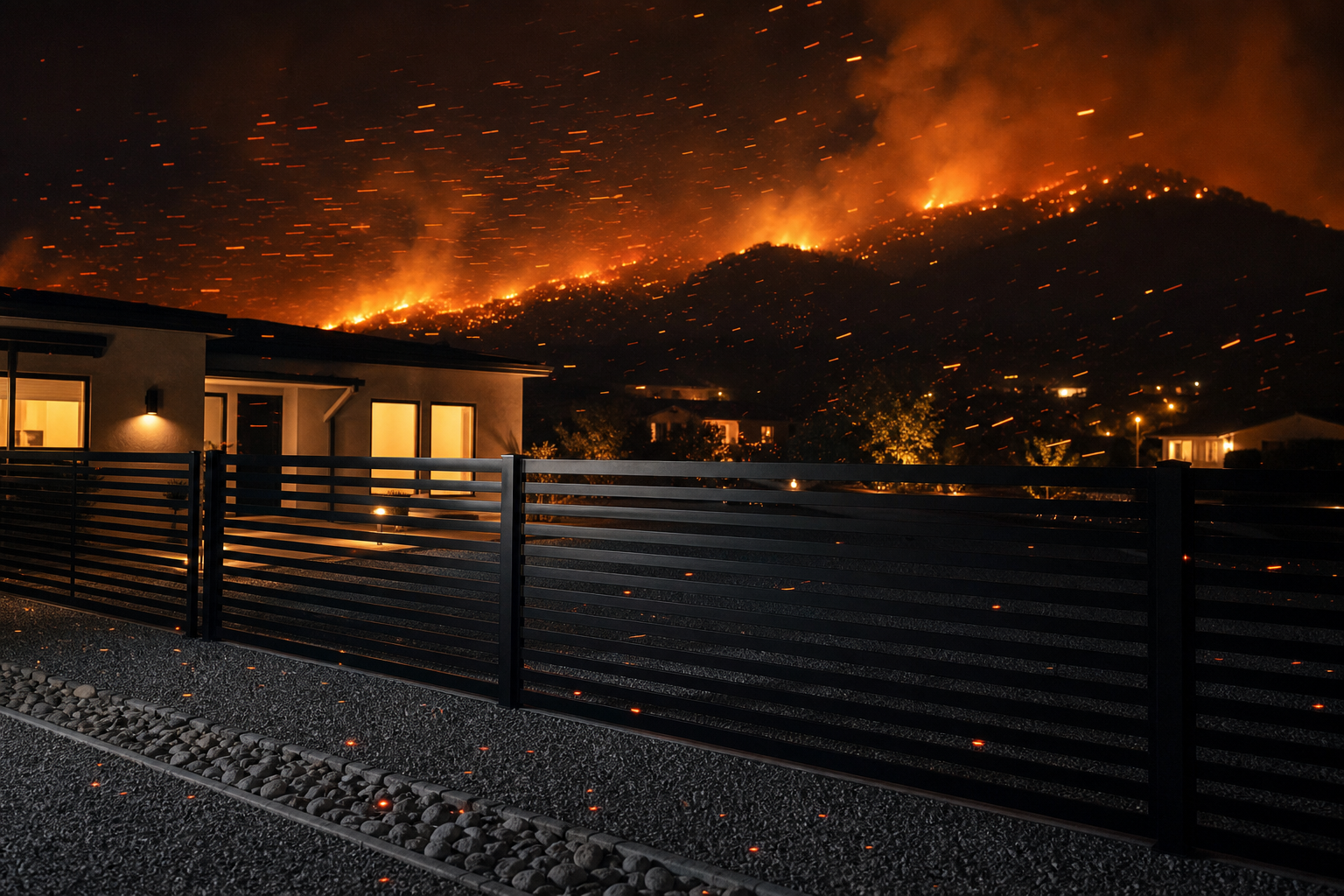
A wildfire throws burning debris a mile ahead of itself. Those embers land in the first five feet around your house — and whatever they land on decides what happens next. Very often, what they land on is the fence.
Why the requirements changed
California’s fire seasons have rewritten the rules for what can sit closest to a home. Whole regions now fall under stricter fire-rating requirements than they did five years ago, and fencing is named directly in the newest of those rules.
That has created a clear line: in the zones where these requirements apply, the fence line has to be fire-rated. Insurers are asking the same question before they write a policy — what is it made of, and how close is it to the house.
Fence Specialties builds both. Where code and carriers require a fire-rated assembly, these are the systems that meet it.

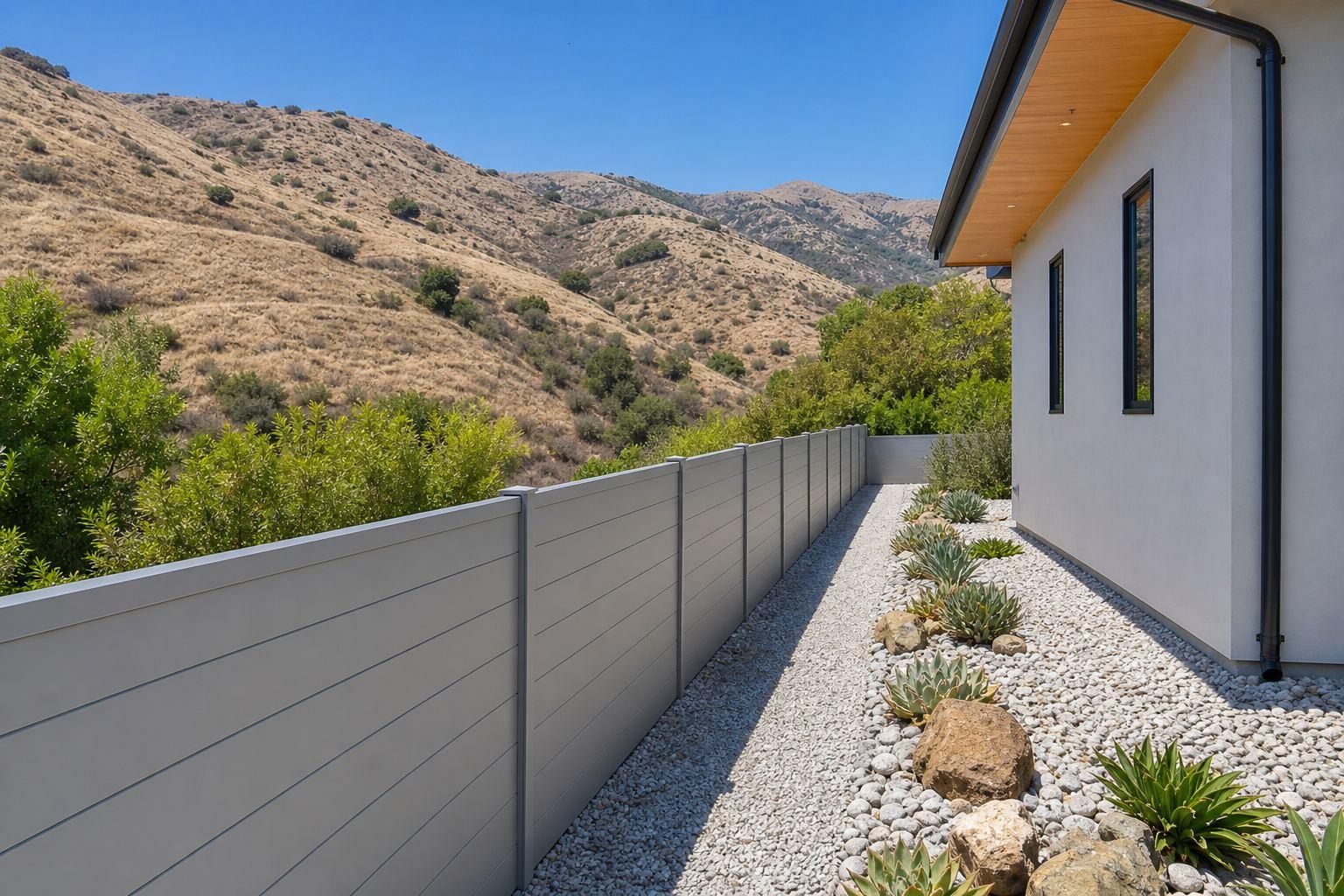
A non-combustible fence line and a gravel finish in the first five feet — the configuration the newer requirements are written around.
Who this is for
They arrive for different reasons, but they all need the same thing: to know what a fence has actually been tested to, and to be able to hand that proof to someone else.
Your carrier is asking for non-combustible material within five feet of the house, or it is declining to renew. You need something specific enough to send back to an adjuster.
If you are in a high or very-high hazard zone you are rebuilding to a heightened standard, and the fence is part of the plan set the plan-checker reviews.
You need the fence to clear inspection the first time, with documentation in the submittal package rather than a promise on a phone call.
You need to know exactly which standard each material was tested to — and which ones were not tested to a US standard — before you write it into a spec.
You have not had a fire and you have not had a letter. You would rather protect your largest investment on your own terms, before a deadline or a carrier decides the timeline for you.
The law
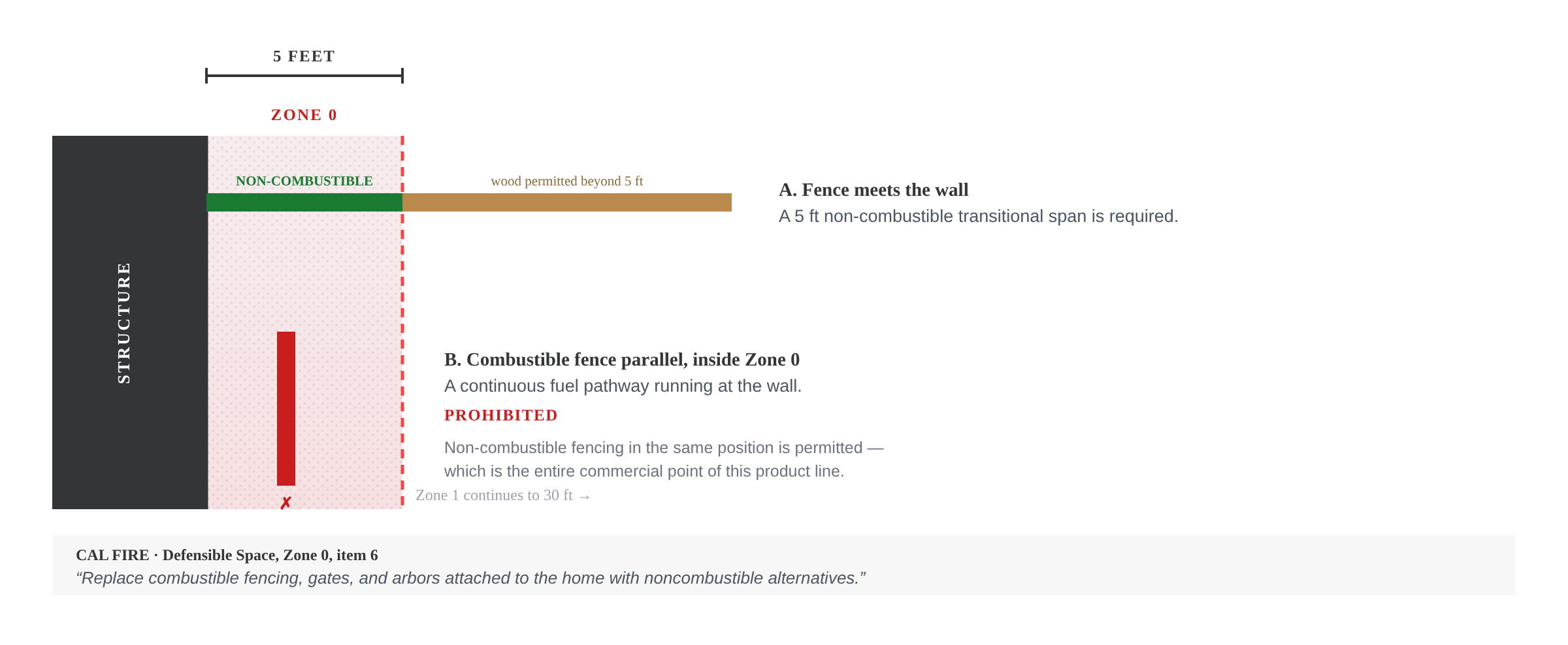
After Santa Rosa, Redding and Paradise, the Legislature accepted what fire scientists had been saying for years: the single greatest predictor of whether a house survives is not the roof or the windows — it is what sits in the first five feet around it. AB 3074 created a new defensible-space zone for exactly that band, and CAL FIRE’s guidance for it lists, as item six:
“Replace combustible fencing, gates, and arbors attached to the home with noncombustible alternatives.”
Fencing is not an afterthought in these rules. It is named, in the state’s own guidance, in the same breath as the roof and the vents.
Swipe the diagram sideways to read it.
Fence geometry above follows the City of San Diego’s Zone 0 guidelines for existing structures (SDMC §512.0604), the most detailed fence language published by any California jurisdiction to date.
Worth being precise, because there is a lot of loose talk about this: the statewide Zone 0 regulations are not final yet. The Board of Forestry is scheduled to vote on adopting them on August 19, 2026. Some cities, San Diego among them, are already ahead of the state and enforcing now.
Insurance is moving faster than the code
You may never be inspected for Zone 0. Your insurer is a different matter — and it is not waiting for the Board of Forestry.
The California FAIR Plan’s wildfire-hardening discounts have been in effect since November 15, 2025. One of the five “immediate surroundings” discounts reads:
“The property has only noncombustible materials incorporated into any improvements to the property, including fences and gates, within 5 feet of the dwelling.”
Twelve such measures stack to as much as 16.4% off the wildfire portion of a dwelling premium. And under regulation 2644.9, every insurer that prices for wildfire risk in California must offer these discounts — the first rule of its kind in the country.

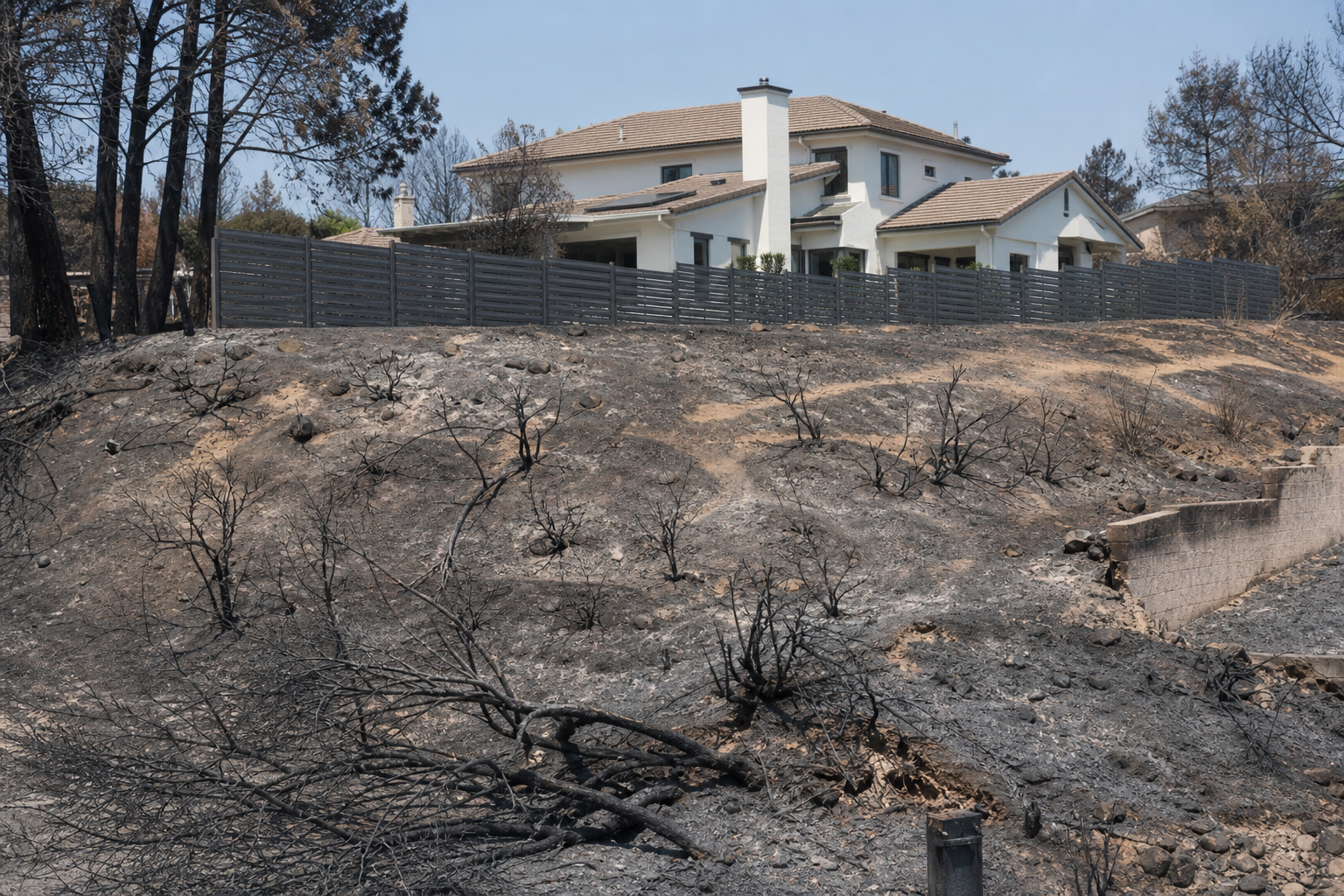
Everything combustible burned. The fence had nothing to give the fire, so the fire stopped at the fence.
What actually qualifies
One point worth knowing when you compare quotes, because it is easy to be misled by it.
California’s State Fire Marshal publishes a WUI Listed Products Handbook — the official directory for Chapter 7A. It covers decking, siding, windows, doors, vents, roofing and treated lumber. There is no category for fencing, so no fence from any supplier carries a “California listed” fire rating.
What the rules and the insurers actually look for is simpler: is the material itself steel or aluminum? Metals qualify on their own merits, with no listing required.
That is why we build our fire-zone systems in steel and aluminum — so what we hand you stands up to a plan check and an insurance review without needing an asterisk.
Compare
We separate US standards from Australian ones on purpose. Both are real testing regimes with real results — but if you are handing paperwork to a California plan-checker, the difference matters, and you should hear it from us rather than discover it at the counter.
| Material | Fire performance | Tested to | Best for |
|---|---|---|---|
| WPC | Class A CA Class A · extended burn | ASTM E84 / E2768-11 United States standard Class A surface burning — not non-combustible | Privacy with a wood look |
| Steel / Colorbond® | Ignitability index 0 | AS 1530.2, Bushfire CRC / CSIRO Australian standard | Privacy, long runs, color |
| Aluminum / Quickscreen | Non-combustible | AS 1530.1:1994 — 0 sec flaming Australian standard | Zone 0, gates, the 5 ft span |
| Fire Rated Glass | Rated by assembly | Per tested assembly Specified per project | Views and sightlines |
Swipe the table sideways to see every column.
“Non-combustible” and “Class A fire-rated” are different claims resting on different standards, and we keep them distinct on purpose. Fire performance is a property of the material and, for glazing, of the whole assembly. If your project carries a specific code or insurance requirement, send it to us and we will tell you which of these four qualifies — and which does not.
The line
Every one of these is non-combustible or Class A tested. They differ in privacy, sightline, color, budget and which document they come with. All four are stocked across our four yards.


The one we can prove to a US standard.
Wood-plastic composite boards in a rigid aluminum frame — the warm horizontal-plank look of timber with none of the rot, insects, painting or fire risk. This is the only product in the line tested to United States fire standards.
| Fire testing | ASTM E84 Class A / E2768-11 California Class A, extended burn |
| Look | Horizontal plank, wood appearance |
| Frame | Rigid aluminum |
| Best for | Full privacy where a wood look is wanted |
Colorbond® steel. It does not ignite.
Colorbond® G550 high-tensile steel in full-privacy panels — Chevron, Vertiline and Linear profiles in 16 colors. Tested to an ignitability index of 0: under test conditions it did not ignite at all. Our own FS steel profile is coming.
| Fire testing | Ignitability index 0 (AS 1530.2) |
| Material | Colorbond® G550 high-tensile steel |
| Profiles | Chevron, Vertiline, Linear — 16 colors |
| Best for | Full privacy, long runs, color matching |
The category insurers point to for the first five feet.
Powder-coated aluminum from Quickscreen USA. Aluminum is a non-combustible metal — it has no fuel value to contribute, which is precisely the language Zone 0 and the FAIR Plan use. Tested at 0 seconds sustained flaming, 0 mm mean flame propagation.
| Fire testing | AS 1530.1 — 0 sec sustained flaming |
| Material | 6000-series aluminum, Interpon powder coat |
| Supplier | Quickscreen USA |
| Best for | Zone 0 runs, gates, the 5 ft span at the wall |
For when the view matters as much as the code.
Transparent perimeters for high-end residential and commercial work. Fire performance for glazing is a property of the whole assembly — glass, frame and installation together — not the glass alone, so these are specified per project.
| Fire testing | Per assembly — specified per project |
| Material | Fire-rated glazing in metal framing |
| Look | Full sightline, minimal visual barrier |
| Best for | Views, pool surrounds, commercial frontage |
Getting it right on site
Swapping the fence is most of the job, but it is not the whole job. Zone 0 also rules out bark mulch, wood chips and stored lumber in that band — so the ground finish matters as much as the panel.
Where a fence runs into the house we install a non-combustible transitional span for the first five feet, then carry your existing material beyond it. You keep the look of your fence and lose the fuse.
Bring us a photo of where your fence meets the house and we will tell you what has to change — and what does not.
Documentation
All 12 documents live on our own site — test reports, advisory notes, brochures and the homeowner insurance checklist. No external links, no dead ends, and we re-verify them against the manufacturers’ current versions every quarter.
Start with this oneAbout the WPC fire testing. WPC is the only product in this line tested to a United States fire standard. It is independently lab-tested to Class A flame spread under ASTM E84 and California Class A with extended burn time under ASTM E2768-11 (SGS report SDFTS25007409R01, 11 December 2025). Full test documentation is available on request for permit submittals. For the first five feet against a structure, California’s Zone 0 rules call for metal, so we pair WPC with our steel and aluminum systems there and draw it that way on your plan.
Talk to a fire specialist
An insurance letter, a plan-check comment, a Zone 0 notice, or a photo of where your fence meets the house. We stock all four systems across San Jose, Riverside, Oceanside and Sacramento — and we will tell you honestly if your project does not need us.
OUR LOCATIONS
Our in-store experts are ready to help you find the right materials for your next project—big or small.
330 Main Street
Riverside CA 92501
(951) 275-9252
Monday – Friday
6:30 am – 3:30 pm
Saturday – Sunday
Closed
2421 Industry Street
Oceanside, CA 92054
(760) 754-9711
Monday – Friday
6:30 am – 3:30 pm
Saturday – Sunday
Closed
1133 North 10th St
San Jose, CA 95112
(408) 995-5294
Monday – Friday
7:00 am – 3:30 pm
Saturday
7 AM–12 PM
Sunday
Closed
6837 Power Inn Rd
Sacramento, CA 95828
(916) 383-8272
Monday – Friday
6:30 am – 3:30 pm
Saturday – Sunday
Closed