

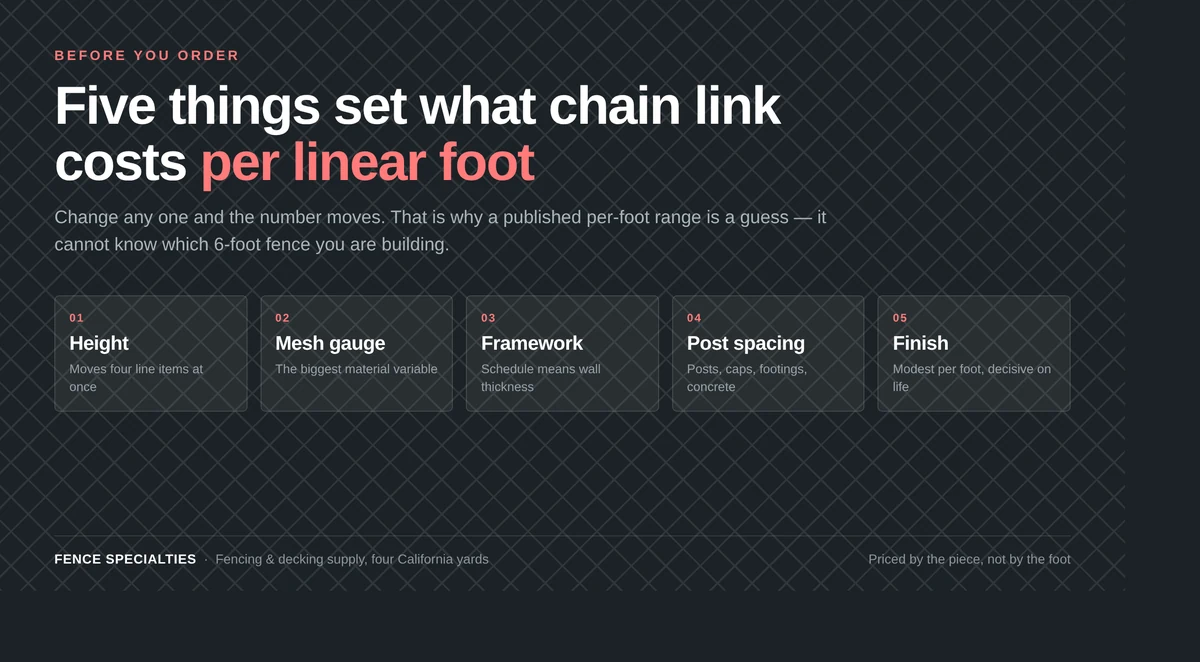
Five things set what chain link costs per linear foot: height, mesh gauge, framework schedule, post spacing and finish. Change any one and the number moves. That’s why a published per-foot range is a guess — it can’t know which 6-foot fence you’re building. Here’s what each dial does.
Why one 6-foot chain link fence costs 40% more than another
Two houses on the same street, both fenced in 6-foot galvanized chain link, and the material bills don’t look alike. Nothing went wrong. They bought different fences.
One took 11-gauge fabric on light framework with posts at 10 feet on center. The other took 9-gauge on SS40 pipe with posts at 8 feet, because the lot catches wind off the pass. Same height, same material, same colour. Different fence.
Chain link is priced by the piece, not by the foot. Fabric by the roll, posts by the each, fittings by the each, rail by the length. The per-foot figure is what falls out at the end once you’ve picked the pieces. Work backwards from a per-foot number and you’ll be wrong in both directions.
| Driver | What changes | Direction of cost impact | What to decide before calling |
|---|---|---|---|
| Height | Fabric width, post length and diameter, rail count, tension bands per termination | Rises fastest — several line items move at once | The finished height you want, in feet |
| Mesh gauge | Wire thickness through the whole fabric | The single biggest material variable | Residential, commercial or security duty |
| Framework schedule | Pipe wall thickness and outside diameter | Large step between residential and commercial | How long it has to stay plumb |
| Post spacing | Number of posts, caps, footings and concrete | Rises sharply as spacing tightens | Wind exposure, slope, and whether slats are going on |
| Finish | Coating type and coating weight | Modest per foot, decisive on lifespan | How far you are from salt air |
There’s a sixth thing that isn’t a dial but changes the count anyway: layout. A gate dropped into the middle of a straight run splits it in two. That’s two more terminal posts, two more sets of fittings, and a second fabric termination — from one gate.
How much does height actually change the cost?
More than the extra feet suggest, because height moves four things at once.
Fabric gets wider, so there’s more steel per foot. Posts get longer and usually fatter. Rail count goes up. And the fittings at every termination multiply, because tension bands are counted off the height.
Rails are the clearest example. Under 5 feet you’re generally running two rails. From 5 to 7 feet, three. At 8 feet, four. Step a fence from 4 feet to 6 feet and you haven’t added 50 percent — you’ve added fabric width, longer and larger posts, another rail across every bay, and two more tension bands at every terminal.
Post length follows height on a rule. On residential work, terminal posts run roughly the fence height plus 2½ feet, line posts about the height plus 2 feet. Commercial framework runs longer still, because it’s set deeper. So a 6-foot residential fence needs 8½-foot terminals and 8-foot line posts before anything goes in the ground.
Post diameter steps up too. Residential line posts are commonly 1⅝ inch up to 5 feet and 2 inch at 6 feet. Commercial work adds 2½-inch line posts at 7 and 8 feet, with 3-inch terminals.
Above 8 feet you’re into commercial and security specification, and in most California jurisdictions you’re also into permit territory. Height limits and permit thresholds are set locally and they vary, so check with your city before you order tall fence.
What does mesh gauge mean, and which one do you need?
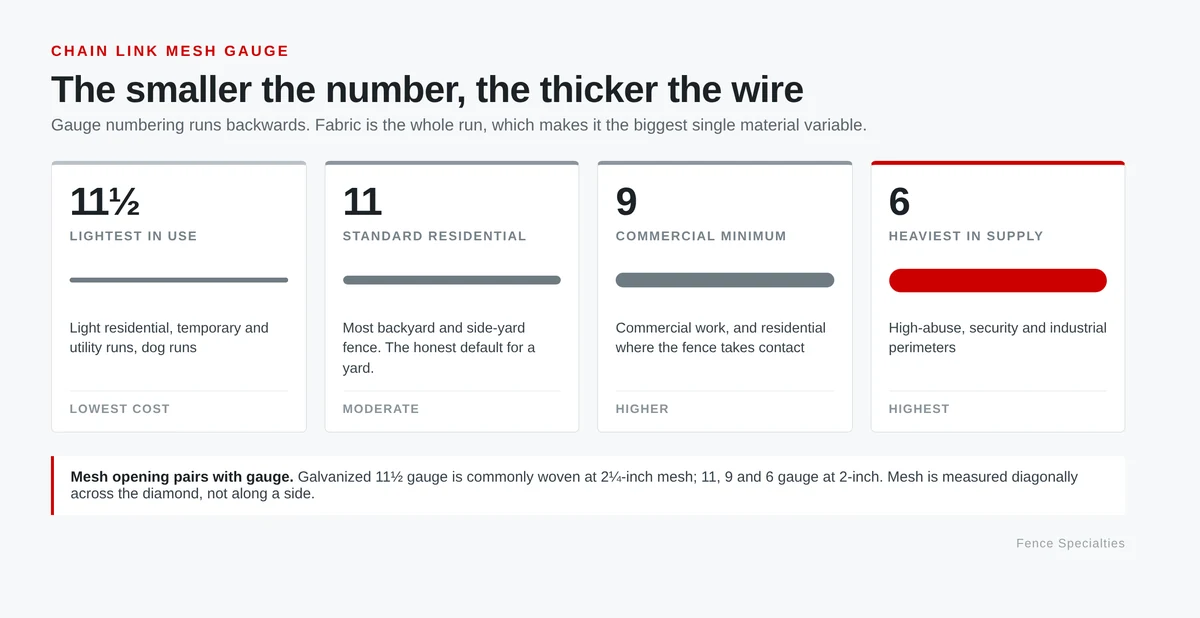
Gauge is the thickness of the wire in the fabric, and the numbering runs backwards. The smaller the number, the thicker the wire. Nine gauge is heavier than 11 gauge. Six is heavier than nine.
This is the biggest single material variable on the page. Everything else on a chain link fence is a handful of pieces. The fabric is the whole run.
| Gauge | Wire thickness | Typical application | Relative cost |
|---|---|---|---|
| 11½ | Lightest in common use | Light residential, temporary and utility runs, dog runs | Lowest |
| 11 | Standard residential | Most backyard and side-yard fence | Moderate |
| 9 | Substantially heavier than 11 | Commercial minimum, and residential where the fence takes contact | Higher |
| 6 | Heaviest in general supply | High-abuse, security and industrial perimeters | Highest |
Mesh opening pairs with gauge. Galvanized 11½ gauge is commonly woven at 2¼-inch mesh. Eleven, nine and six gauge are commonly 2-inch. Vinyl-coated fabric is available in 2-inch and in a tighter 1¼-inch. Mesh is measured diagonally, corner to corner across the diamond, not along a side.
For a residential yard, 11 gauge is the honest default. Eleven-and-a-half will hold a line and cost less, and it will show its lightness if anything leans on it. Nine gauge on a backyard fence is not wasted money if the fence is containing large dogs or backing a driveway, but it is more fence than most yards need.
For anything commercial, 9 gauge is where the conversation starts, not where it stretches to.
Framework: what schedule and diameter do to the price
Framework is the pipe — line posts, terminal posts, top rail. The word people miss is schedule, which means wall thickness.
Two 2-inch posts can look identical on the rack and carry very different steel. That difference is most of the price gap between a residential fence and a commercial one, and it’s the whole difference between a fence that stays plumb and one that leans in five years.
| Designation | Wall thickness | Typical use | Relative cost |
|---|---|---|---|
| Light / SS20-class | 0.085–0.095 inch depending on diameter | Residential and light commercial | Lower |
| SS40 | 0.111–0.130 inch depending on diameter | Commercial, wind-exposed, gates | Higher |
| Schedule 40 structural | Heaviest in common supply | Industrial, security, heavy gate posts | Highest |
Two numbers worth carrying to the counter. Residential-grade framework starts at about 0.065-inch wall. The thin pipe sold in big-box stores can run as low as 0.035-inch wall, which you can bend over your knee, and it is not framework — it’s tube.
Posts are also priced by job, not just by size. Line posts sit between the ends and do the least work. Terminal, corner and gate posts carry the fabric tension and are larger, longer and dearer. Gate posts are sized off the gate leaf, not off the fence, which surprises people.
How the framework goes together is a separate subject, and it’s worth reading before you buy: setting framework, mesh and tension.
Why post spacing changes your total more than you expect
Ten feet on center is the common maximum for line posts. Most residential chain link is set at 10 feet and holds fine.
Close that to 8 feet and the arithmetic bites. On a 100-foot run, 10-foot spacing needs nine line posts. Eight-foot spacing needs eleven. That’s two more posts, two more loop caps, two more footings, two more bags of concrete, and more tie wire. Repeat it across a whole property and the total moves noticeably, on a decision that never appears in a per-foot quote.
Three things push spacing tighter. Wind exposure, which the Inland Empire and the passes see plenty of. Slope, because a stepped fence gains posts at every step. And privacy slats, because slats turn an open fence into a solid one and a solid fence is a sail. If slats are going on, the post schedule has to be decided at the same time — not after.
Grade change is worth working out before you count anything. Slopes, utilities and property lines covers what to check on the ground first.
What the hardware actually adds
Fittings are the line item people leave out of their own estimate, and the one that catches them at the counter.
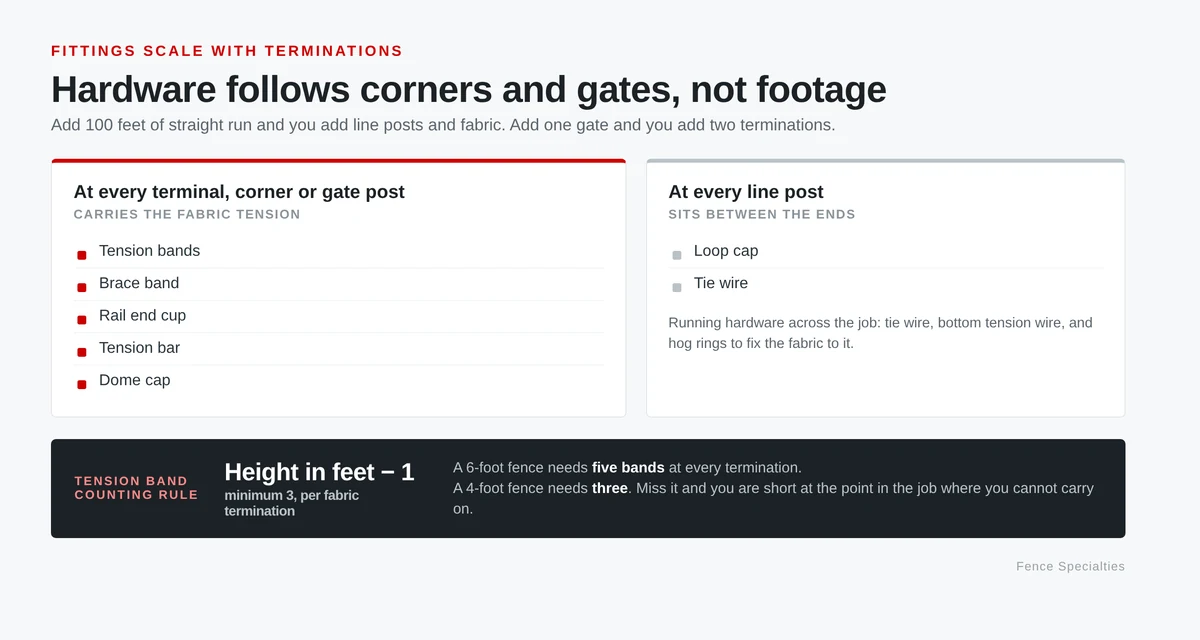
The important thing about fittings is that they scale with terminations, not with footage. Add a hundred feet of straight run and you’ve added line posts, caps, fabric and ties. Add one gate and you’ve added two terminal posts and everything that hangs on them.
At every terminal post you’re pulling tension bands, a brace band, a rail end cup, a tension bar and a dome cap. Line posts take a loop cap and nothing else.
Tension bands have a counting rule, and it’s the most useful number on this page: fence height in feet minus one, minimum three, per fabric termination. A 6-foot fence needs five bands at every termination. A 4-foot fence needs three. Miss it and you’re short at exactly the point in the job where you can’t carry on.
Then the running hardware — tie wire along the rails and posts, hog rings to fix the fabric to the bottom tension wire, and the tension wire itself, sold by the foot or in rolls. Individually small. Across a property, not.
Finish: galvanized, vinyl-coated, aluminized
Finish moves the per-foot cost less than gauge does. It moves the service life more.
Galvanized is the default, and there are two things to know. Fabric can be galvanized before weaving or after weaving, and it carries a zinc coating weight — ASTM A392 covers zinc-coated chain link fabric, with Class I at 1.2 ounces and Class II at 2.0 ounces of zinc per square foot. Class II is more zinc and lasts longer. Anywhere the air carries salt, that difference stops being a preference.
Aluminized fabric is covered by ASTM A491 and holds up well against corrosion.
Vinyl-coated is a polymer coat over galvanized wire. It costs more, it comes in black, green and brown, and it reads as a much less industrial fence. It’s also the finish most people actually want in a front yard.
Where you are decides which is worth it. Within about a mile of the water in Oceanside or Carlsbad, salt finds the thinnest coating first and finds it at the welds and cut ends. Heavier zinc or a vinyl coat earns its cost there. Inland in Riverside or out in the Sacramento Valley, the enemy is sun and heat rather than salt, and standard galvanized does the job — a vinyl coat there is an appearance decision, which is a perfectly good reason to buy one.
Finishes and fabric are on the chain link fence materials page.
Slats, windscreen and privacy add-ons
Slats and windscreen do two things to the bill, and only one of them is obvious.
The obvious one is the material itself — slats by the foot of fence, windscreen by the panel or roll. The one people miss is that both convert an open fence into a closed one. Wind stops passing through and starts pushing.
That changes the framework decision underneath. A slatted 6-foot fence on a wind-exposed lot wants tighter post spacing and heavier framework than the same fence bare. Deciding on slats after the posts are set is how a fence ends up leaning in its second winter.
If privacy is the goal, price the slatted version as its own fence, not as a bare fence with an add-on.
What to bring to the counter for an accurate number
Total footage on its own tells a yard almost nothing. It can’t produce a post count, a fitting count or a fabric quantity, because none of those follow from perimeter. Bring these instead.
Per-stretch dimensions. Break the line into straight runs and measure each one. A stretch ends at a corner, an end, or a gate.
Gate locations and widths. Where each gate sits and how wide the opening is. Remember a gate inside a run makes two runs.
Height. The finished height you want.
Grade change. Where the ground falls, and how much. This decides whether the fence steps or follows the slope.
Finish and gauge, or the duty. If you don’t know the gauge, say what the fence has to survive and the counter will tell you.
Existing posts, if you’re tying in. Measure the diameter of what’s there. Wrap a string around the post, measure the string, divide by 3.14.
If you want to work it out before you go, measuring your fence line walks through it. Then call your nearest branch and describe the job in one conversation instead of three.
We don’t publish a per-foot price, and the reason is in the first table. By the time you’ve picked a height, a gauge, a schedule, a spacing and a finish, any number published in advance is wrong for most of the people reading it. Bring the list and we’ll give you a current figure on the fence you’re actually building.
Common questions
Why can’t you just tell me the price per foot?
Because five variables set it and we don’t know yours yet. Height, mesh gauge, framework schedule, post spacing and finish each move the number, and gates and corners move it again. A published range would be wrong for most readers by the time they’ve made those choices.
Is thicker wire worth it for a residential fence?
Sometimes. Eleven gauge handles a normal backyard. Move to 9 gauge if the fence is containing large dogs, backing a driveway or taking regular contact. If nothing leans on it, 11 gauge is the sensible spend.
What gauge is standard for a backyard fence?
Eleven gauge for most residential work. Eleven-and-a-half is lighter and cheaper and is common on utility and temporary runs. Commercial work starts at 9 gauge.
Does a taller fence cost proportionally more?
No — more than proportionally. Height widens the fabric, lengthens and fattens the posts, adds a rail, and adds tension bands at every termination. Four line items move together.
Why do corners and gates cost more than straight runs?
They’re terminations. Every corner, end and gate post carries tension bands, a brace band, a rail end cup, a tension bar and a dome cap, and it’s a larger, longer post to begin with. A line post takes a loop cap.
Is vinyl-coated worth the premium over galvanized?
Near the coast, often yes, because the coating adds a barrier where salt does its work. Inland it’s mostly an appearance decision. Both are legitimate reasons to buy it.
Come see it at the counter
Bring your per-stretch measurements, gate widths and the height you want, and we’ll build the material list with you and give you a current number.
Fence Specialties Riverside — 330 Main Street, Riverside, CA 92501 · (951) 275-9252
Call ahead on a large order and we’ll have it staged when you pull in. All four yards stock chain link fabric, framework and fittings.