Proven for 50 years in the harshest fire country on earth.
Colorbond® steel is Australia’s most widely used fencing system, developed and tested across half a century of bushfire, cyclone, coastal salt and desert heat. Fence Specialties supplies it in the United States.
It is a full-privacy, non-combustible fence with an ignitability index of zero — available in three panel profiles and sixteen colors, including neutrals that read like a white vinyl fence from the street.
Colorbond® is pre-painted steel sheet. It is a metal, so there is no ignition temperature to reach and no fuel to contribute. Its ignitability index is 0 — the lowest value the test scale has.
This is the distinction that matters when a plan reviewer or an insurer looks at your drawing. Class A rated materials describe how slowly flame spreads across a surface. Non-combustible materials do not burn at all — and California’s Zone 0 rules for the first five feet around a structure are written around non-combustibility, not flame-spread class.
Why Australia matters
Tested where the fires are worse than ours
California and south-eastern Australia are the two most fire-exposed developed landscapes in the world, and Australia got serious about fencing first. Their building code has a formal scale for how much fire a structure must survive — the Bushfire Attack Level — and the top of that scale, BAL‑FZ, means the flame front reaches the building itself.
Colorbond® steel is used in BAL‑FZ zones. That is not a marketing position; it is a code classification under AS 3959:2018, earned by burning fence assemblies at a government test facility until they failed or didn’t.
So when we bring this system to a Californian hillside, we are not asking you to trust a new product. We are importing something that has already been argued out in front of regulators in a country that loses towns to fire.
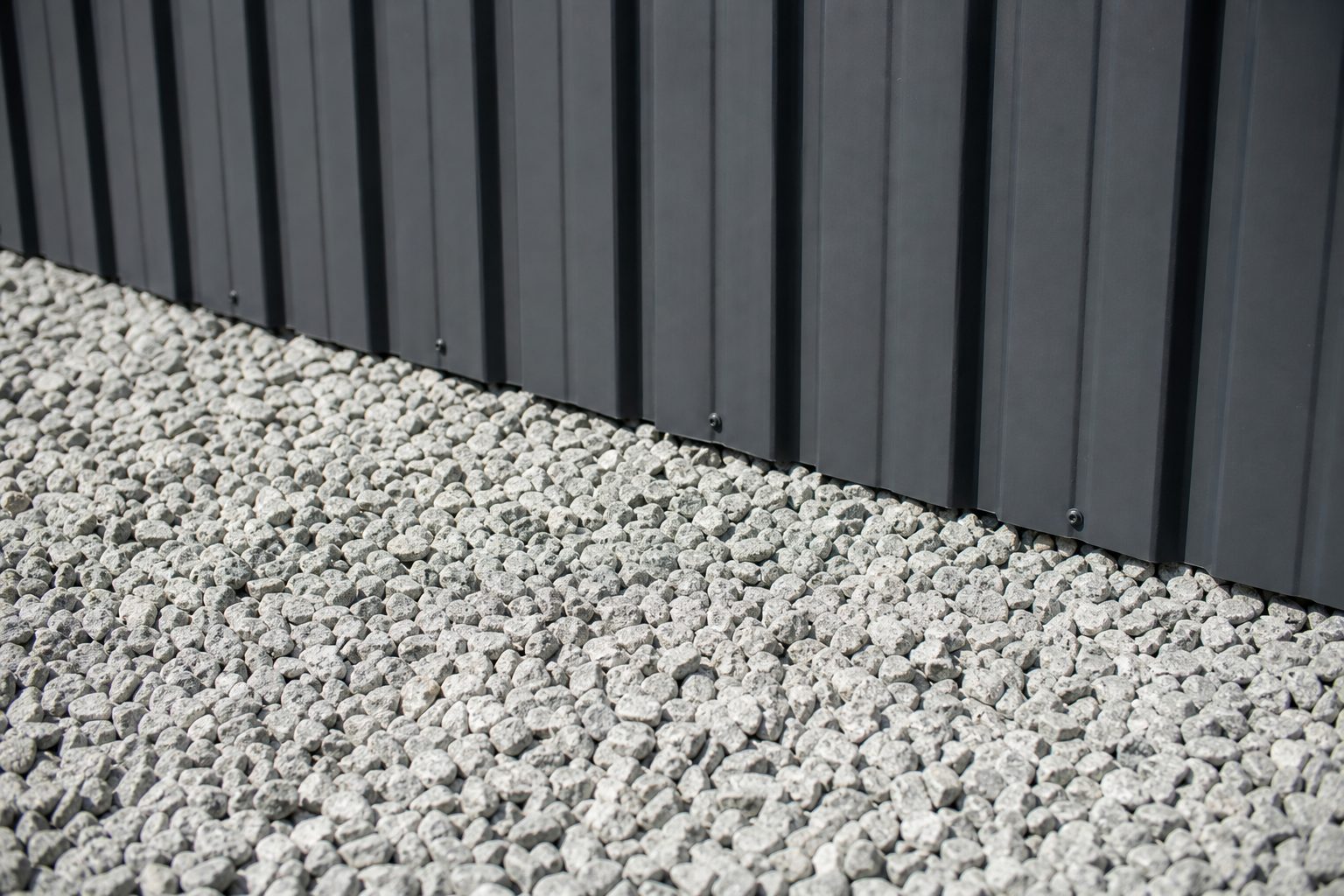
The first five feet: steel panel, bare gravel, nothing at the base that will hold an ember.
How homes are actually lost
Embers arrive first, and they arrive early
A wildfire throws embers a mile or more ahead of its front. They do not need a wall of flame to reach you — they need somewhere to land and something to feed on.
A fence is a continuous line of material running from the property boundary directly to the house. Built from timber or composite, that line is a fuel path. Built from Colorbond® steel, the embers land on a metal surface, glow, and go out.
Illustration of wind-driven ember exposure — not a photograph of a Fence Specialties or CSIRO test.
The fire testing
A government fire laboratory burned it, and it held
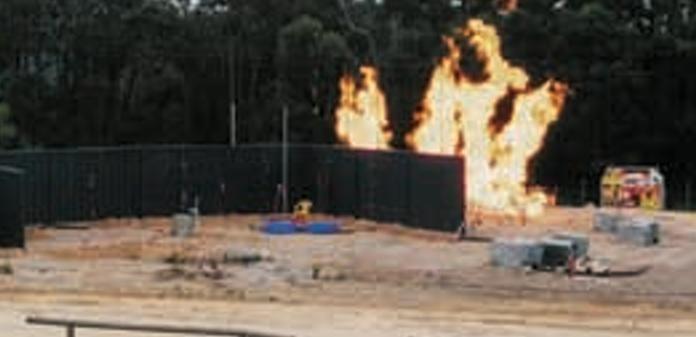
The evidence for Colorbond® is not ours and it is not the manufacturer’s marketing department. The Bushfire Co-operative Research Centre and CSIRO — Australia’s national science agency — built complete fence assemblies from competing materials and burned them at the NSW Rural Fire Service experimental testing site, believed to be the only bushfire simulator in the world when the study was run.
From the study itself: a steel fence assembly under direct flame exposure at the NSW Rural Fire Service test site. This is a photograph of the actual test, not an illustration.
“Pre-painted and metallic coated sheet steel fencing performed best under all exposure conditions.”
“Even when faced with a 30-minute flame immersion test used to simulate the potential effects of an adjacent house fire.”
Bushfire CRC / CSIRO — residential boundary fencing in bushfires
What each exposure did to it
Litter ignited
Leaf litter piled on the fence rails and around the posts, then lit — the single most common real-world ignition. No structural failure.
Litter + pre-radiation
The litter fire plus sustained radiant heat, reproducing an advancing front that has not yet made flame contact. No structural failure.
30-minute flame immersion
Full flame engulfment for half an hour, modelling the house next door burning down. Performed best of all materials tested.
Where this sits in California code
Non-combustible is the strongest thing a fence can be
California’s Zone 0 is written around non-combustibility, and steel is non-combustible. That is a property of the metal itself rather than a rating someone issues — it needs no certificate, it cannot expire or be revised, and it answers the requirement on its own terms. That is a stronger position to be in than holding a flame-spread class.
The Bushfire CRC and CSIRO research above sits on top of that as independent, fence-specific evidence — conducted to Australian standards, on real fence assemblies, which is more than most fencing materials anywhere can claim. It tells you how this steel behaves in a fire; non-combustibility is what satisfies the code here. The two work together.
Two things worth knowing so you are never caught out. California’s WUI Listed Products Handbook has no fencing category, so no fence in any material holds a ‘Class A fence’ listing in this state. And where you see Colorbond® described as “aligning with NFPA Class A requirements,” that is a comparison of characteristics rather than a certificate, and we keep that distinction clear so your submittal holds up.
If your submittal needs a specific listing number, send us the drawings early and we will confirm in writing exactly what exists for the assembly you are specifying.
The fence is still standing. So is the house behind it.
Non-combustible construction in the first five feet is the cheapest insurance you will ever buy on a hillside lot.
Illustration of post-fire condition — not a photograph of a specific property.
How the sheet is built
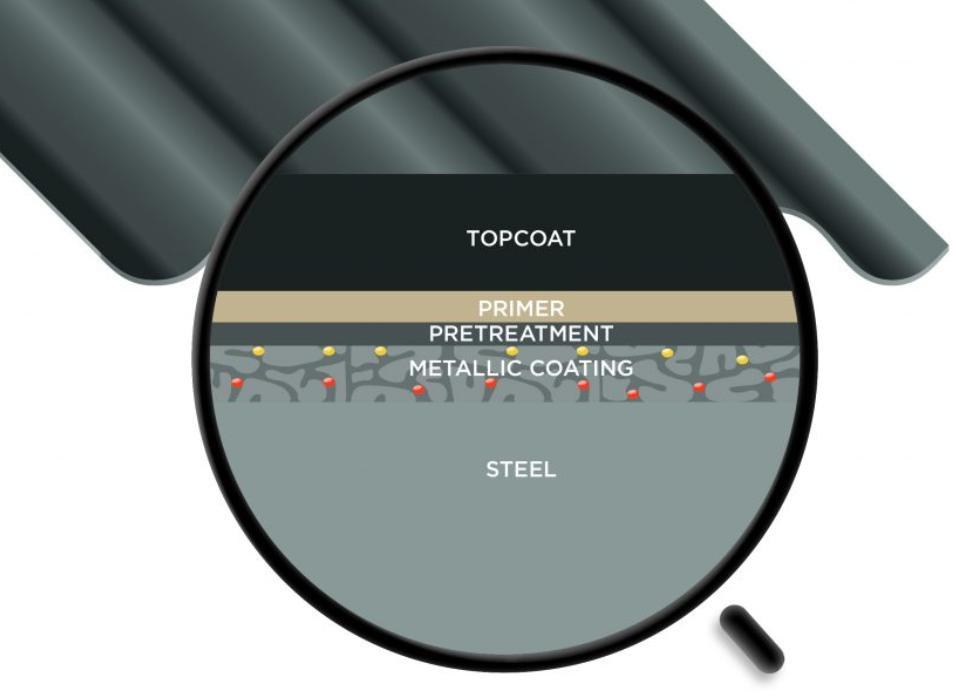
Five layers, each doing one job
Fire resistance comes from the steel. Everything else in a Colorbond® sheet exists so the fence still looks new in fifteen years — which, on a fence you bought for safety, is what stops it being replaced for cosmetic reasons.
1 Steel base
G550 high-tensile steel to Australian Standards AS 1397 and AS/NZS 2728 — grade and tensile strength verified before any coating goes on.
2 Metallic coating
BlueScope’s metallic coating system across the full surface, for corrosion resistance in coastal and high-humidity sites.
3 Pretreatment
A thin adhesion layer, so every coating above it bonds properly and stays bonded.
4 Inhibitive primer
A corrosion-inhibitive primer baked on — a second barrier against moisture reaching the steel.
5 Exterior topcoat
Baked exterior-grade paint, formulated against chipping, flaking and blistering, and to hold its color under UV.
The coating stack, magnified. Manufacturer cross-section.
Check that yours is genuine
Real Colorbond® steel is engraved on both sides of every infill sheet, at 23 5/8" vertical spacing. No engraving means it is not genuine Australian-made Colorbond® — and none of the testing on this page applies to it.
Choose the face
Three panel profiles
All three use 27-gauge nominal steel infill sheet and the same channel post and rail structure. The difference is the texture the street sees.
Chevron
Zigzag profile
An angular infill pattern that throws shadow and reads as movement along a long run. Suits contemporary and architecturally expressive homes.
Vertiline
Trapezoidal rib profile
The classic vertical rib. Clean and structured, and the most forgiving choice next to traditional housing stock. The default for most residential runs.
Linear
Premium ribbed profile
A refined, smoother rib with the flattest face of the three. Specified most often on high-design residential and commercial elevations.
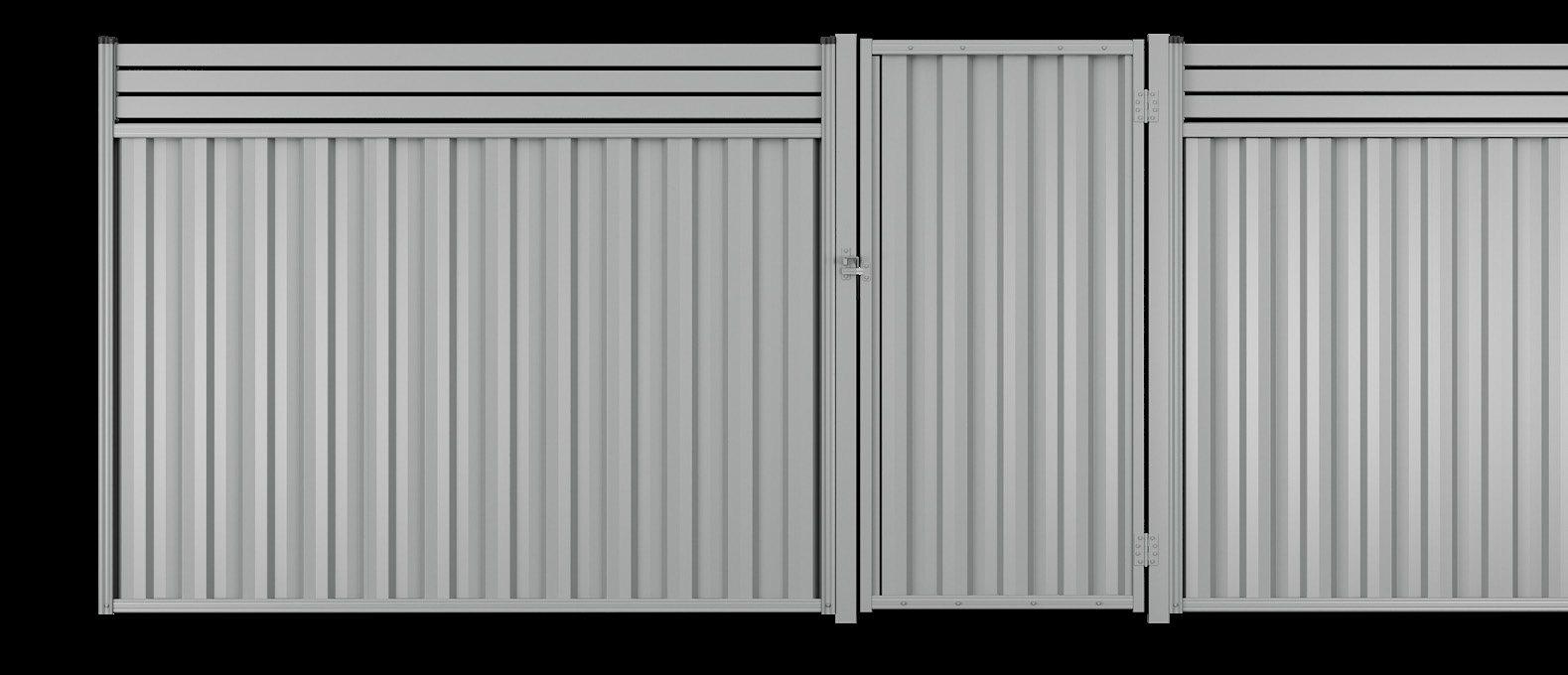
Panel and matching gate in elevation. Gates are built to match the panel profile and color, so the run reads continuously.
The numbers
Sizes and specification
Panel width is adjustable on site because each infill sheet overlaps the next — you change the overlap rather than cutting a sheet. That is why a Colorbond® run closes out neatly against an existing wall without a filler panel.
Panel widths
93" and 123" — adjustable via infill sheet overlap
Gate widths
35 1/2" standard, matched to panel profile and color
Panel heights
4’, 5’, 6’ and 7’ — 6’ is the common residential height
Slat topper
10" high, added above the base fence height for adjustable privacy
Infill sheet
27-gauge steel (nominal), all three profiles
Post & rail
3.5 × 1.5" channel post; 2.5 × 2.25" rail
Sixteen colors
Colors drawn from the landscape
The Colorbond® palette is built to sit against rooflines, gutters, fascias and stucco rather than fight them. It includes neutrals that approximate a white vinyl fence from the street — useful in an HOA that wrote its rules before steel was an option.
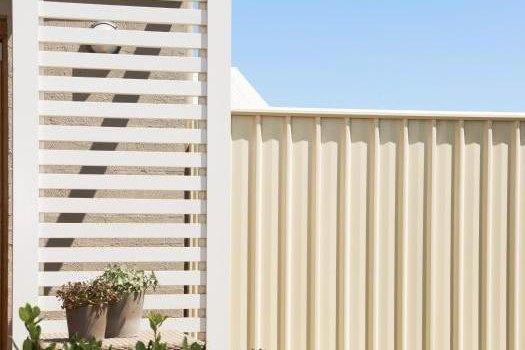
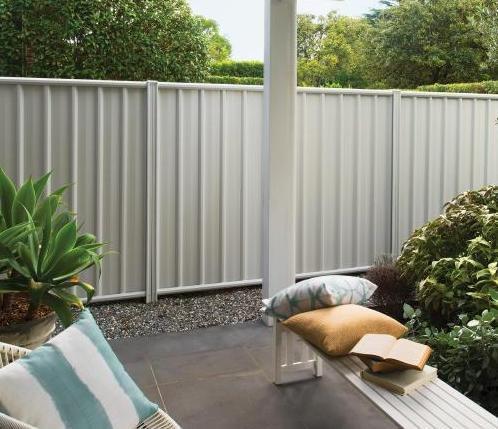
A lighter neutral with a matching slat screen — the configuration most often used to satisfy a vinyl-fence covenant with a non-combustible product.
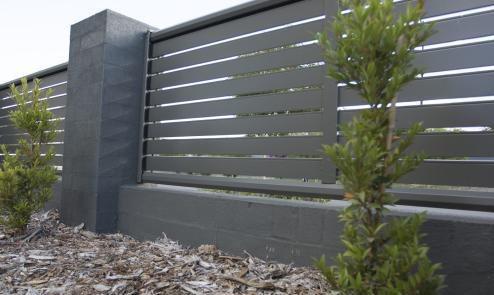
A dark slat topper carried above an existing block wall to add height and privacy without rebuilding the wall.
Detailing tip: match rails and posts to the infill color for a single flat plane, or specify a contrasting channel post and rail to frame each panel. The second option reads as more deliberate on long, unbroken runs.
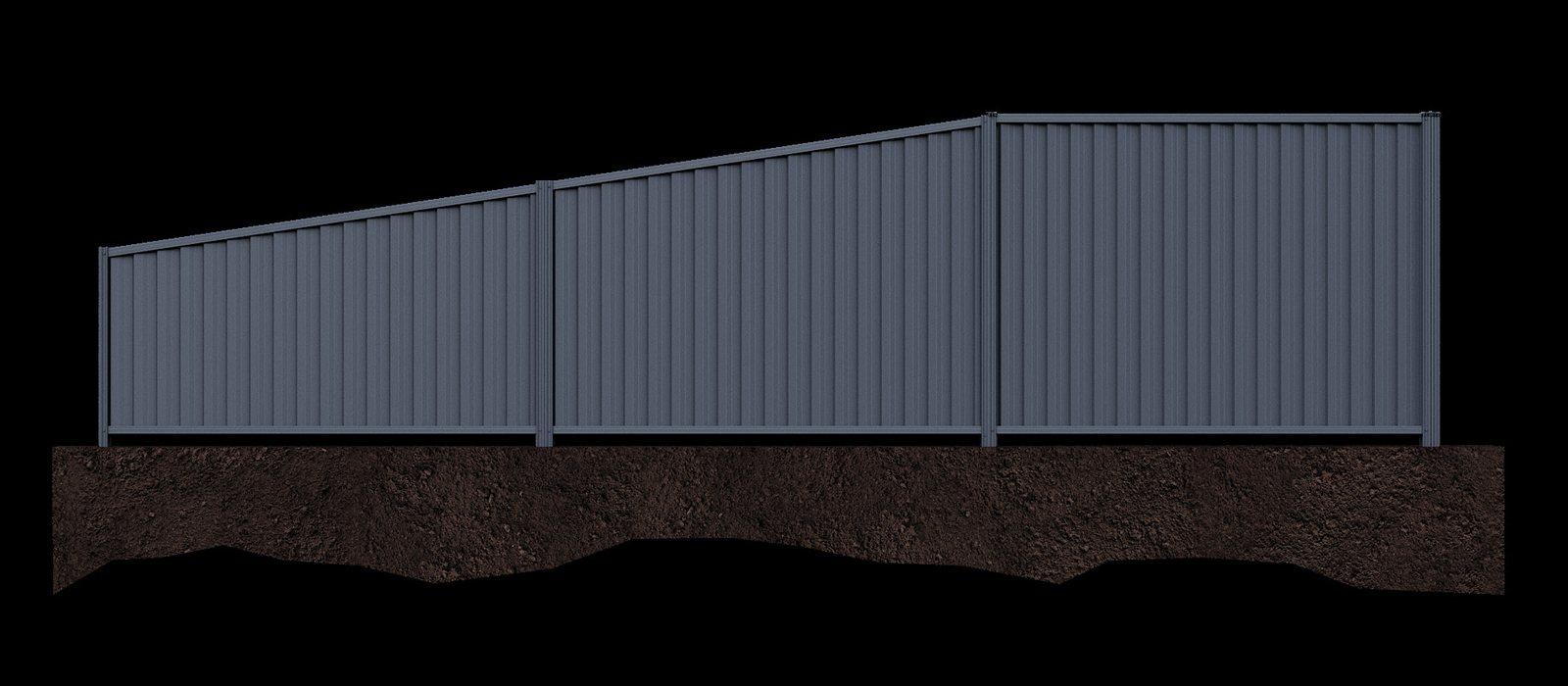
Sloping and uneven sites
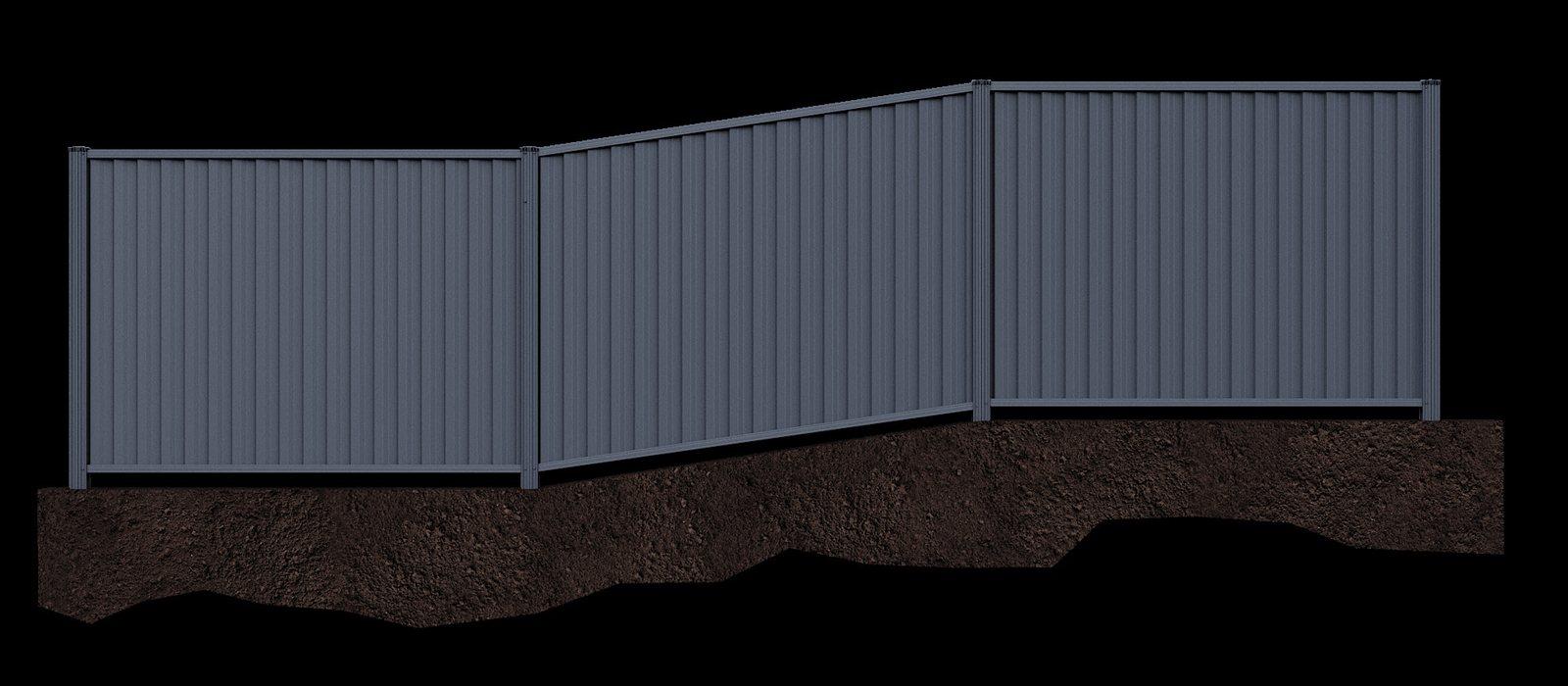
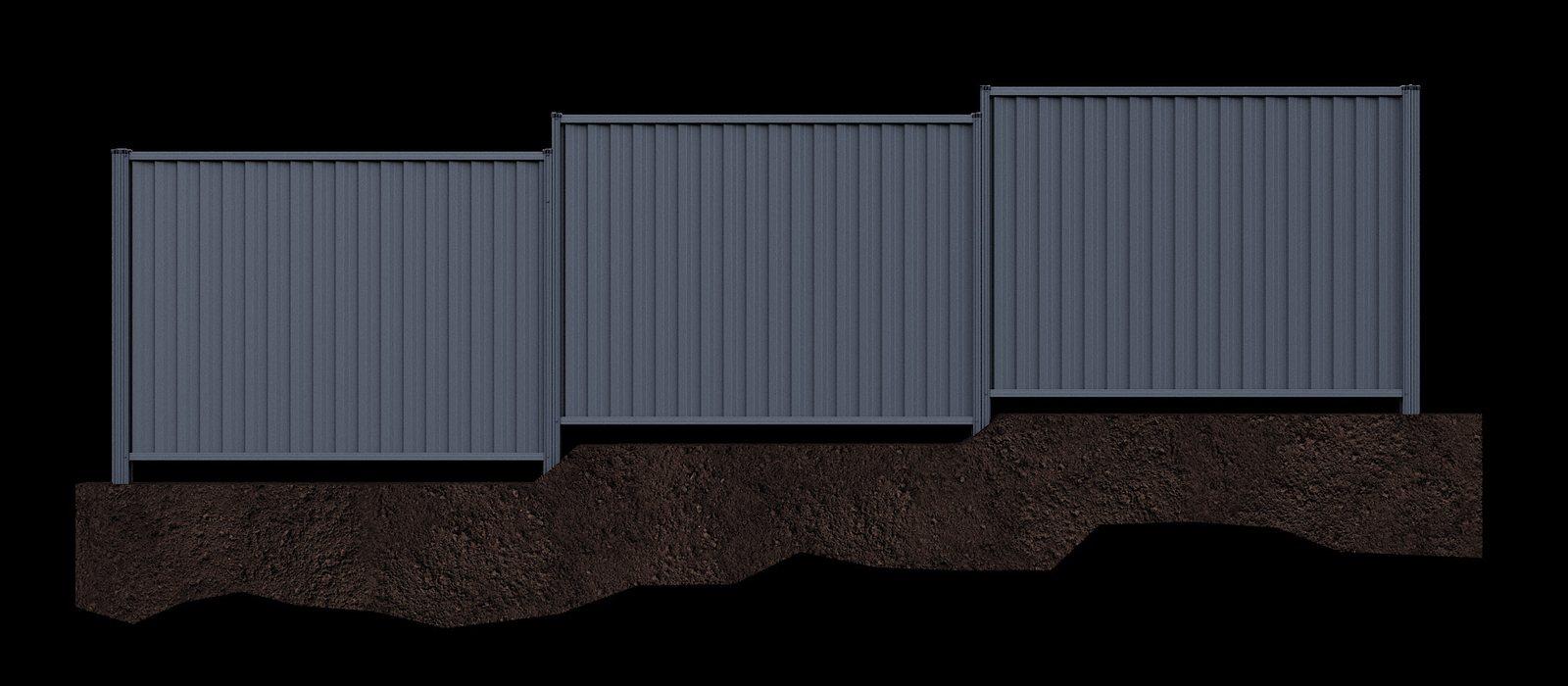
Three ways to follow your ground
Most fire-exposed lots in California are on a grade. How the fence handles that grade is a design decision, not just an installation detail — and it matters for Zone 0, because a gap under a panel is somewhere for litter to collect.
Raked
Infill sheets are cut to the gradient and the rails follow the same slope, so the fence flows with the land. Best on a continuous, even slope. No gaps at the base.
Stepped
Each panel stays level and the run steps at each post. A formal, structured look that suits landscaped gardens. Watch the triangular gap at each step on a steep grade.
Tapered
The panel top is cut to an angle while the bottom stays level — used where a run has to drop to a lower height at a driveway, path or entry. The most architectural of the three.
The rest of the case
What you get the other 364 days a year
Nobody buys a fence only for the one day. Colorbond® earns its place on a boundary for reasons that have nothing to do with fire.
Complete privacy
Overlapping infill sheets leave no sight line and no gap — unlike a board fence, which opens up as timber shrinks.
G550 high-tensile steel
A high-strength fence, which matters for wind loading and for anything leaning on it.
No painting, ever
The finish is baked on at the mill. There is no annual staining or sealing cycle, and nothing to rot at ground level.
Termites are irrelevant
There is nothing in a steel fence for an insect to eat — a real consideration across Southern California.
Coastal salt resistance
The metallic coating and inhibitive primer are specified for marine air; relevant to our Oceanside and San Diego work.
Wind engineered per site
Wind classification is calculated from region, terrain roughness, shielding and topography. Ridge-top and hillside lots load a fence far harder than flat ground — we specify to the site, not to a catalogue default.
Installed
On real boundaries
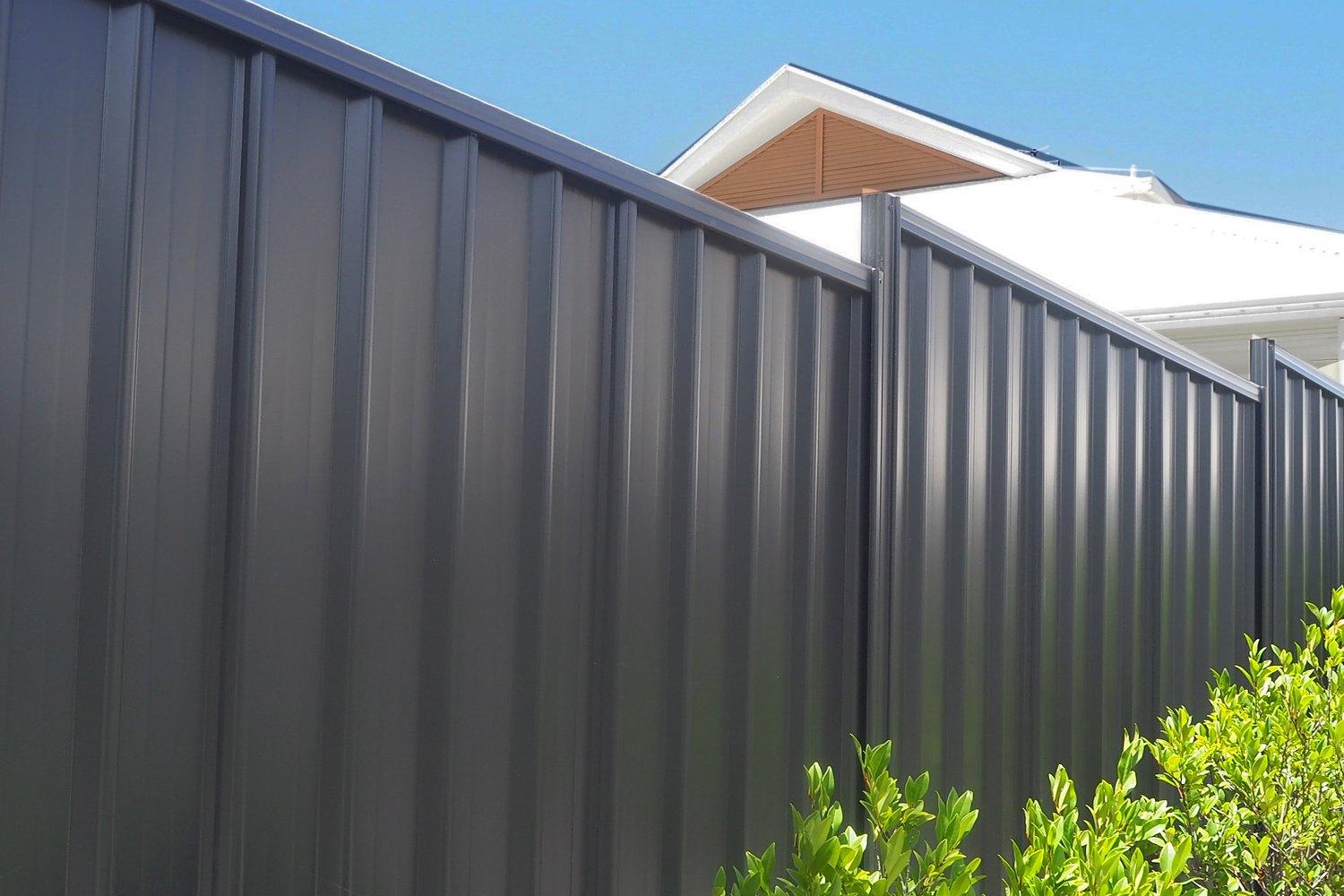
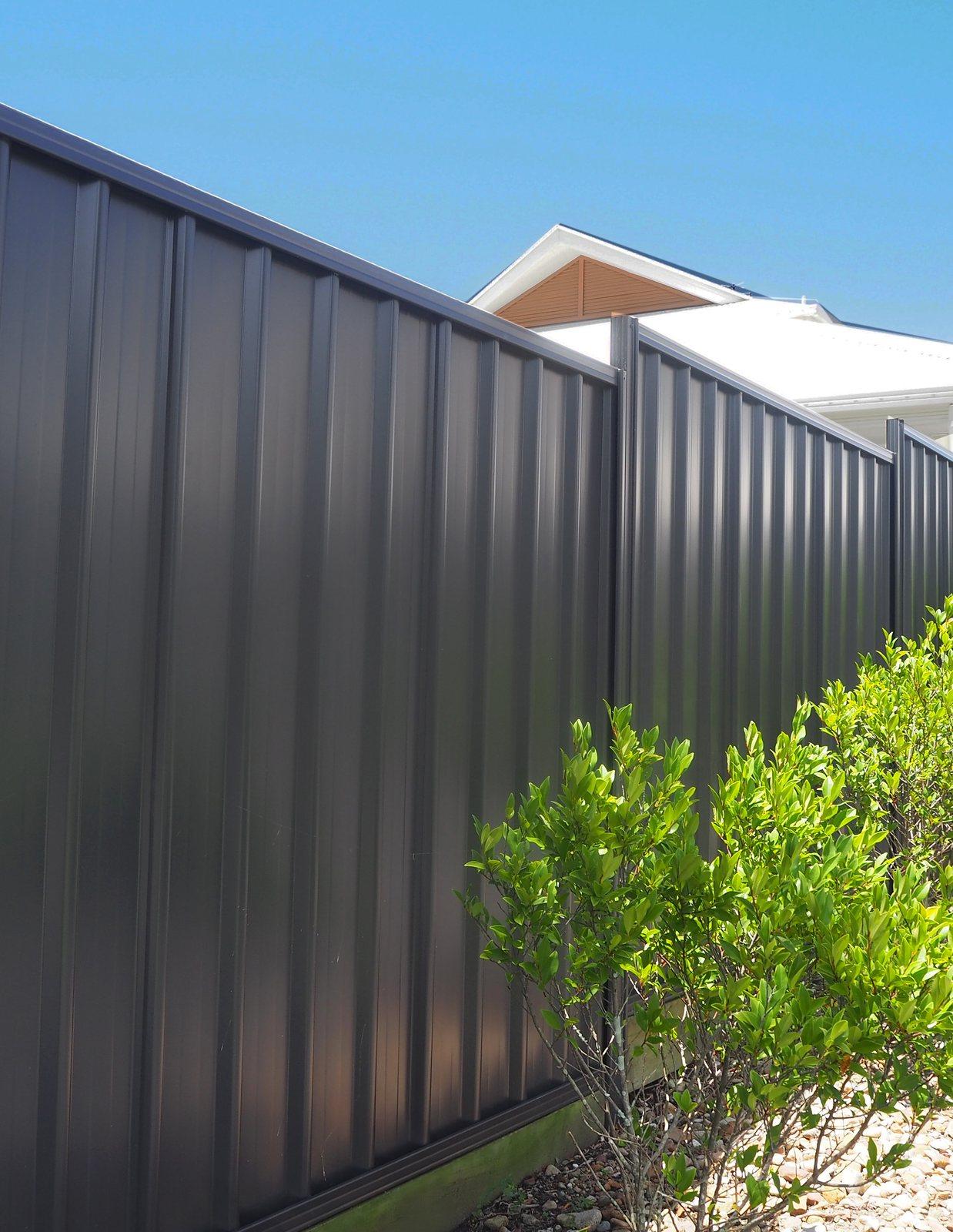
A dark profile alongside the house. Note the ribbed face reading as metal, not vinyl.
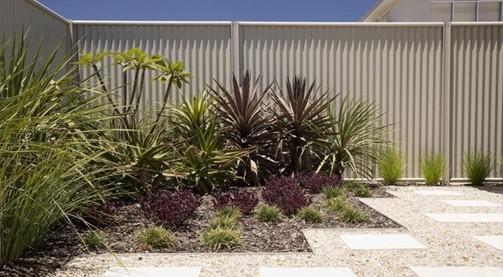
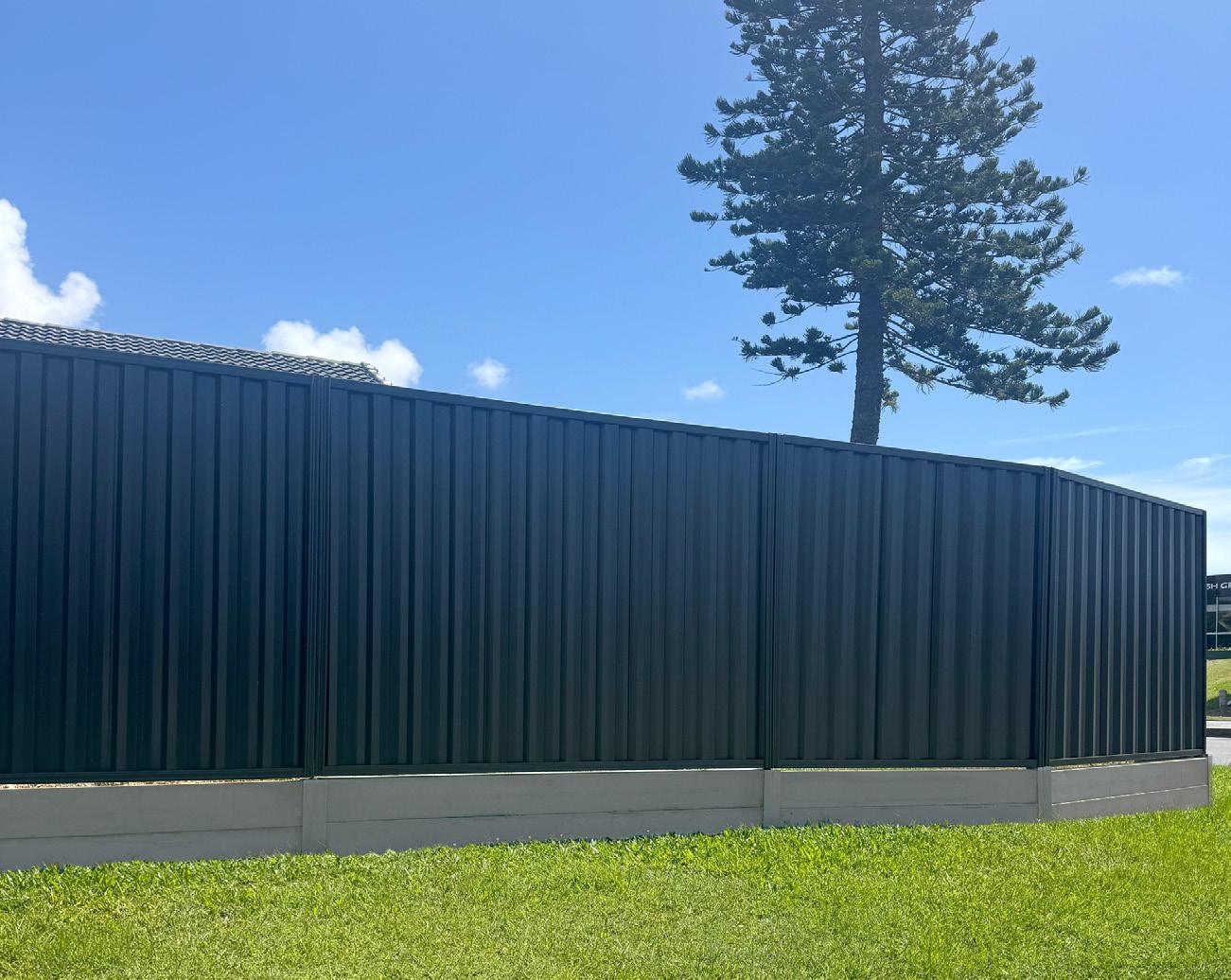
Dark colors recede visually and make a small yard read larger.
A lighter neutral in a poolside enclosure.
Monument in a continuous run — no pickets, no gaps. A fire-rated fence should not look like safety equipment.
Colorbond® steel in a dark profile — the ribbed face reads as metal, not vinyl.
The paperwork
The documents you’ll be asked for
Hosted here on our own site, so the version you download is the version we are supplying. We re-check these against the manufacturer’s current release every quarter.
PDF · Product overview
Colorbond® Steel Fences & Gates Brochure
Full product overview — panel profiles, panel and gate assembly, installation types and the color range.
Tell us the site — grade, exposure, HOA constraints and whether a submittal needs a listing number. We will come back with a profile, a color, a configuration and an honest read on the paperwork.