The WPC Firewall System is a composite fence board carried in a non-combustible aluminum frame. It reads as a warm horizontal wood fence from the street. It has been independently lab-tested to Class A flame spread under ASTM E84, and to California Class A with extended burn time under ASTM E2768-11 — the 30-minute version of the same test.
It is the answer for a homeowner who wants the wood look back after a fire, without putting a continuous strip of fuel along the property line again.
Almost everyone who calls us about WPC had a wood fence. They liked how it looked and they are not willing to give that up — they are just no longer willing to run a continuous strip of dry timber around a house in fire country.
Wood also loses the argument on its own terms. It greys, it cups, it cracks, it needs sealing, and the boards start going one by one around year seven.
WPC answers both objections with one product: the warm horizontal grain look, in a board that is Class A rated for flame spread and does not need staining to stay looking new.
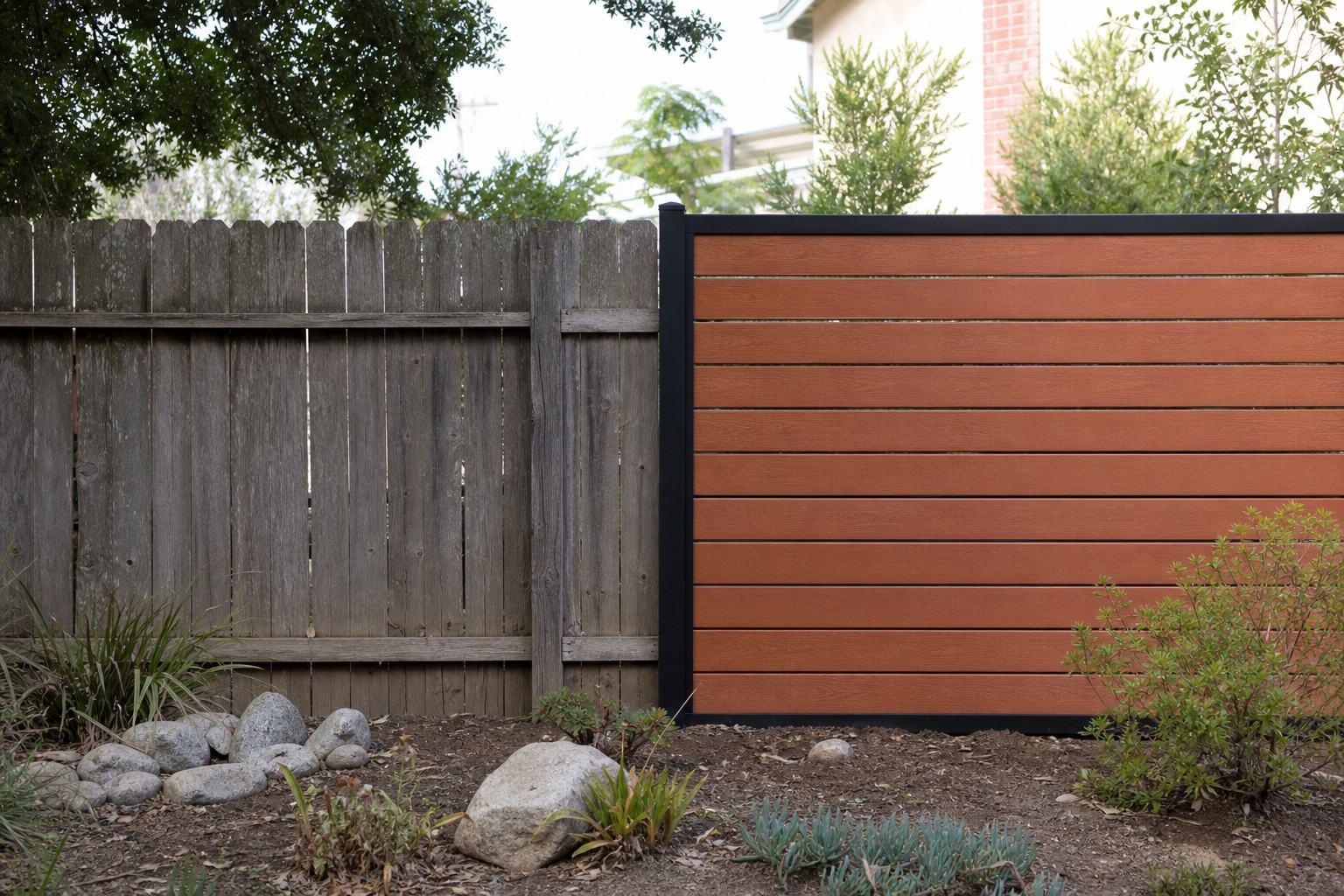
Left: what fire country does to timber. Right: WPC boards in an aluminum frame.
What it actually is
A composite board, carried in an aluminum frame
WPC stands for wood-plastic composite — wood fibre bound in a thermoplastic polymer. On its own that is still a combustible material. What makes this a fire product is the system: the boards sit in a 3×3″ 14-gauge aluminum post and rail frame that is non-combustible on its own, and the board itself is formulated and tested to hold a Class A flame-spread rating.
There is nothing to paint, stain or seal. It does not rot, and insects have no interest in it. Boards are tongue-and-groove and slide down the post channel from the top, so a panel goes together without notching, routing or specialty tools.
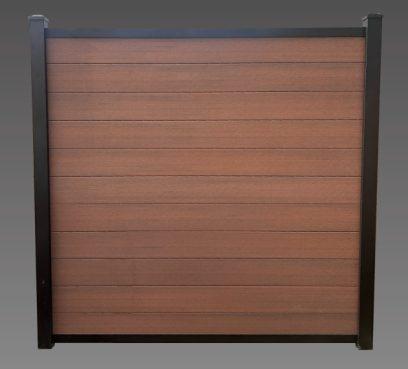
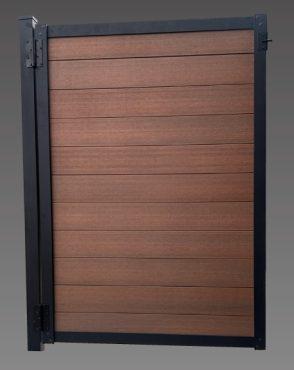
6′×6′ panel — black frame, redwood board fill.
The evidence
What the lab actually found
Independent testing by SGS, report SDFTS25007409R01, dated 11 December 2025. The test method was ASTM E2768-11(R2018), the extended-duration test California references, run on the same tunnel apparatus as ASTM E84. The report states the material “met the requirements of Class A” and met the requirements of the full 30-minute duration — Class A, and California Class A with extended burn time.
25
Flame spread index
Class A is 0–25. Lower is better.
300
Smoke developed index
Class A allows up to 450.
10.5 ft
30-minute flame travel
Measured down the test tunnel.
Class A
Result
The highest ASTM E84 flame-spread class.
Full test documentation is available on request for permit submittals — just ask your branch and we will send it across.
Where WPC works best
Class A rated, with the look people actually want
WPC has earned a Class A flame spread rating under ASTM E84 — the top classification for how fire travels across a surface — and California Class A with extended burn time under ASTM E2768-11, which runs the same test for 30 minutes instead of 10.
That makes it a strong choice along the property line and anywhere the fence is what people actually see, which is most of the run on a typical job.
Right at the house, California’s Zone 0 rules call for metal, so we pair WPC with our steel and aluminum systems for that first five feet. Most projects use both, and we design it that way from the start.
How we design it
Along the property line WPC — Class A rated, with the warm wood look on the stretch of fence everyone sees.
The first five feet at the house Our steel or aluminum systems, which meet the Zone 0 material requirement.
Most projects use both: metal at the structure, WPC down the property line. We will draw it that way on your plan.
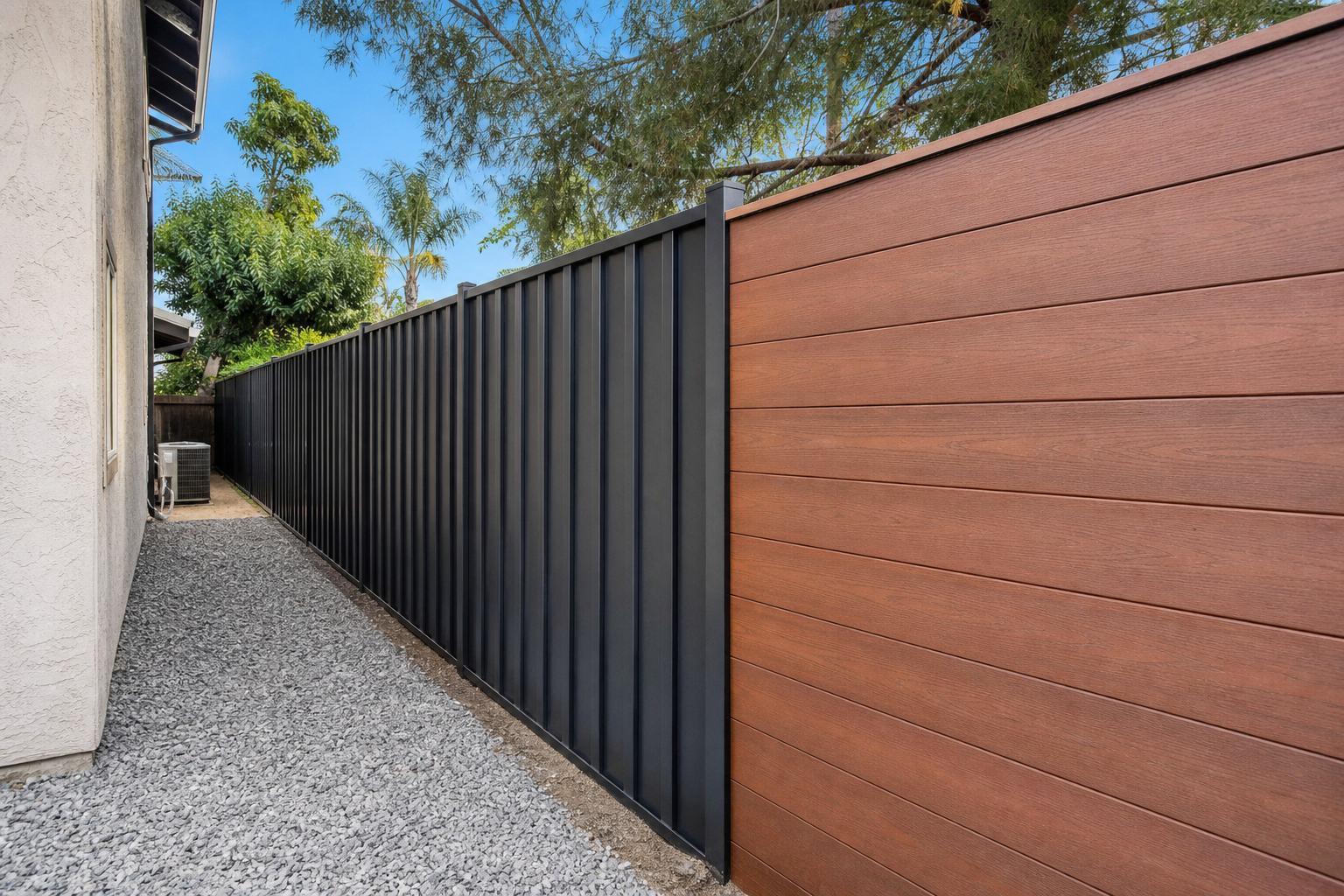
How most of our fire-country projects are drawn: non-combustible metal for the first five feet off the structure, WPC for the long run where the fence is what people actually see.
For your submittal
Name the WPC board and the rating comes with it
The Class A result belongs to the WPC board fill, so naming the WPC board specifically on your submittal keeps the tested rating with the assembly. Tell us the plan calls for Class A and we will make sure what we supply matches what was specified.
What you get to live with
Why homeowners choose it
Here is what you get to live with.
A fence that looks like a good timber fence on the day it was finished, and still looks like that in year ten — no staining, no sealing, no cupped boards, no annual argument with the weather. In fire country you get all of that with a Class A rated board.
Ownership
What we stand behind, and what to expect
5-year limited warranty
The WPC Firewall System is our own product, so the warranty is handled in-house. There is no third-party manufacturer to route a claim through and no overseas supplier to wait on — you call us.
Full terms, including what is and is not covered, come with the submittal package.
Color, honestly
Composites lighten slightly in strong sun. Industry guidance is up to 8% in the first six months, after which the color stabilises. A sample of ours left in direct sun for seven weeks showed no visible fading.
The part that matters day to day: it fades evenly across the whole panel. Wood goes blotchy and grey in patches. WPC shifts a shade, uniformly, and then holds.
The warranty covers abnormal fading beyond industry tolerance — not normal gradual change.
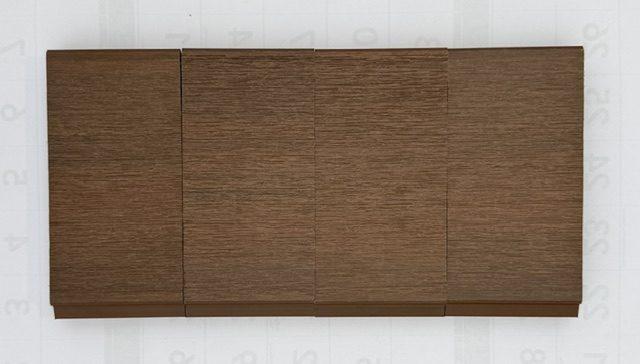
Redwood board surface, as supplied.
The system
What arrives on site
The system ships as packs rather than assembled panels, which keeps freight damage down and lets a crew build to the run they actually have.
Post pack — one 3×3″ 14-gauge post, one cap, and full step-by-step assembly instructions.
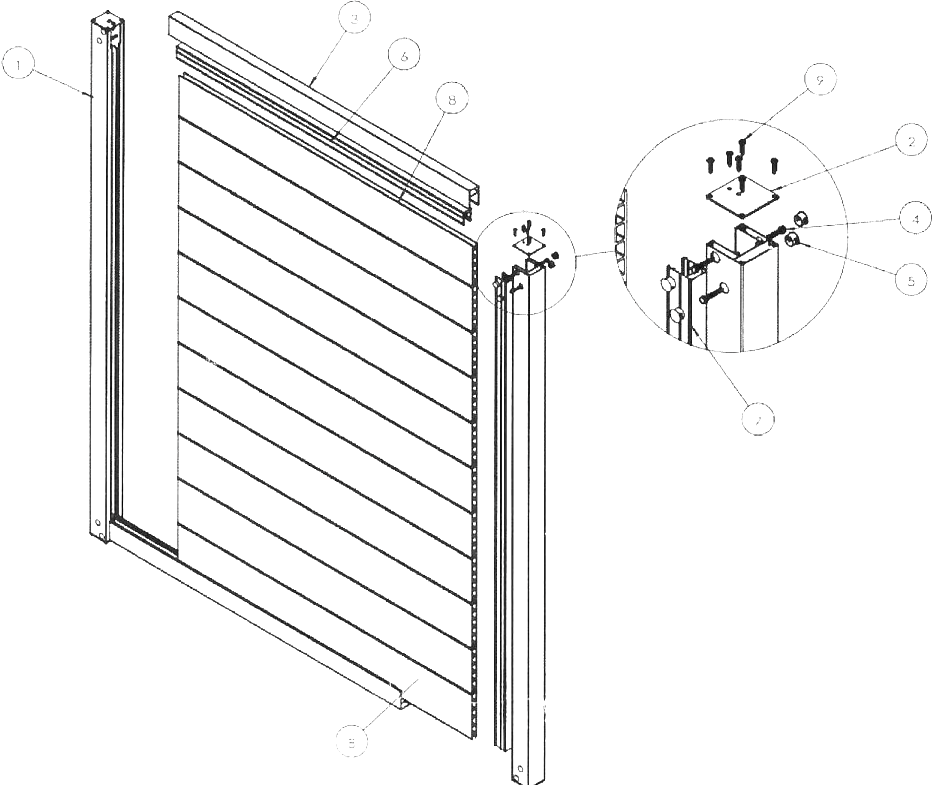
6′×6′ frame kit — two 70-9/16″ 16-gauge rails, two 63-7/8″ C-channel side frames, top and bottom spacers, four L-brackets and screws.
Gate kit, in two boxes — eleven 45″ boards in one, and the frame kit, uprights, rails, caps, hardware, hinge set and latch in the other.
Gate kit, assembled — matching frame and board fill.
Because the gate uses the same frame and the same board fill as the panels, the gate does not read as a separate object in the run. That is the detail people notice on a finished wood fence and almost never get on a metal one — the gate usually gives the game away.
Installation
Three ways it goes in
Summarised from the installation instructions that ship with the system. The full guides are in the downloads below — these are the shape of the job, not a substitute for them.
In-ground
Set the post in an 8″ diameter hole, 2′ in ground.
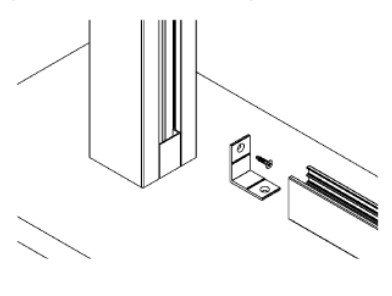
Slide the 2″ bottom spacer down from the top of the post.
Fit the bottom L-bracket into the rail, face up.
Slide in the bottom rail and check level before going further.
Slide the side frames into the channelled posts.
Slide in the WPC board fill, one board at a time.
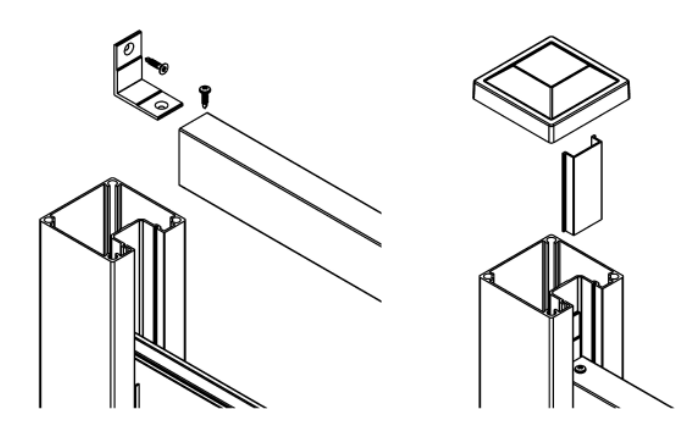
Fit the top L-bracket, then the 1-5/8″ top spacer.
Install the post cap.
Surface mount
Mark and pre-drill four 3/8″ holes.
Fix post and plate to the surface, locking into place.
From there, follow the in-ground sequence from the bottom spacer onward.
Used on concrete, pavers and other hard surfaces where digging is not practical.
Gate
Same method as a panel, built into the gate uprights and rails.
Cut the frame to height if required.
Fix the bottom rail to the upright with hex screws.
Fit the bottom cap with 3/4″ pan screws, then the plugs.
Trim 1/2″ off two fill boards for a 68″ gate.
Slide in a trimmed board, nine factory boards, then the second trimmed board.
Fit the top rail and cap.
Gate weight
A standard 3×3″ 14-gauge post carries a 4′-wide gate kit. An assembled gate kit runs roughly 95 lb, so plan the hinge selection around that.
Specifying it
Sizing and part numbers
Board coverage is 6″ per picket, so net fence height works out as:
(pickets × 6″) + 2″ = net height
Which gives the three heights we build most:
11 pickets → 68″ 10 pickets → 62″ 7 pickets → 44″
Cutting posts down? Order the spare caps and the touch-up texture at the same time. It is the one thing crews call back for.
Part #
Item
FSWPC64GTKTBLKRD
6×4 WPC Gate Kit — black frame, redwood tongue-and-groove board fill
FSWPCPSTPLTBLK
WPC post plate & trim, black — 4-3/4″ square plate, trim kit with glue and screws
FSWPC3PSTCPBLK
3×3 WPC post cap, black — spares for when posts are cut down
FSWPC194PSTFLRBLK
1×94 WPC post filler, black — full-length spacer to finish a run or an unused side of a 3-way post
FSWPCLBRKT
WPC L-bracket set for cut frame kits
FSWPCSPBLK
FS WPC spray paint / texture, black — touch-up for cut edges
The paperwork
The documents you’ll be asked for
The test report, the spec and the install guide — the three things a plan reviewer, an insurer or an installer will ask you for. No portals and no hunting through a manufacturer’s site, and the link you send today still works next year.
Fire test documentation
ASTM E2768-11 / E84 — available on request
Independent SGS testing, report SDFTS25007409R01, dated 11 December 2025: Class A flame spread under ASTM E84, and California Class A with extended burn time under ASTM E2768-11.
Brochure
WPC Firewall System brochure
Component breakdown, product photography and finish options for the complete system.
Send us the run and we will tell you what qualifies
Give us the linear footage, the height you want, and how close the fence comes to the house. We will come back with the material split — where WPC works and where the first five feet needs metal — and a figure.