

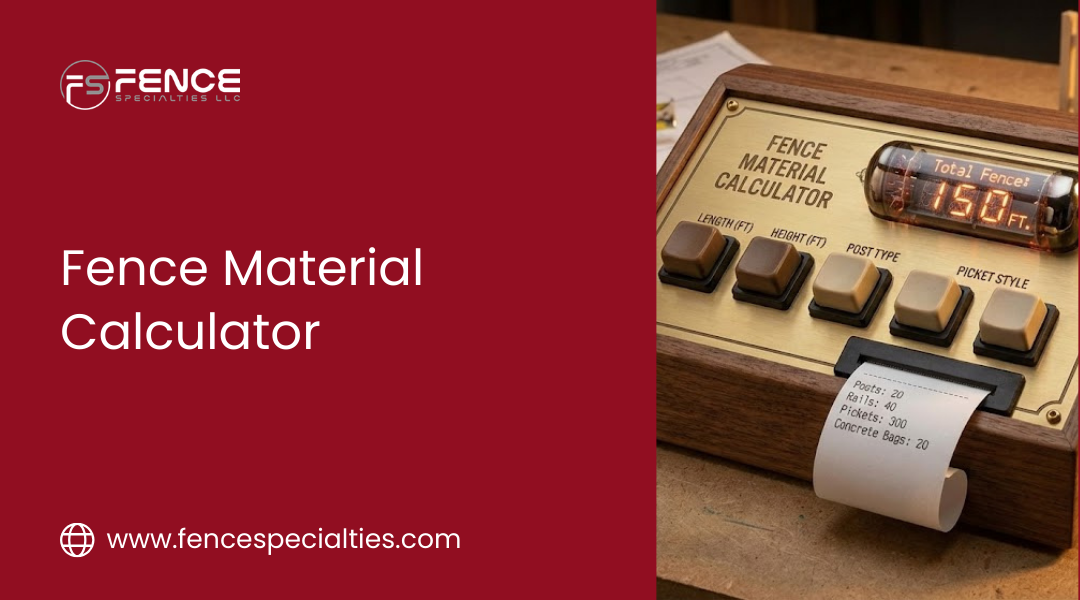
Planning a fence project means getting your material counts right from the start. Ordering too little leads to delays and extra trips, while ordering too much wastes money on materials you won’t use. To estimate fence materials accurately, you need to measure your fence line length, determine post spacing (typically 8 feet for wood fences), calculate the number of rails based on fence height, and count pickets or boards based on their width and any spacing between them.
The math behind fence estimates involves more than just measuring the perimeter of your property. You’ll work with linear footage, account for posts at corners and gates, factor in the style of fence you’re building, and understand how different materials affect your final quantities. Each decision you make about height, spacing, and board width changes the amount of lumber, concrete, and hardware you need to buy.
This guide walks you through the complete process of measuring and estimating materials for your fence project. You’ll learn the logic behind post spacing, how to calculate rails and pickets for different fence styles, and what variables affect your material list. You’ll also see how real-world conditions in places like Riverside, California influence the way fence suppliers and homeowners approach these estimates.
Defining Project Boundaries And Assumptions
Your material calculations depend on knowing exactly where your fence starts, stops, and how it follows your property’s unique features. Understanding setbacks, terrain changes, and partial repairs prevents ordering too much or too little material.
Property Lines, Setbacks, And Exclusions
You need to identify your legal property lines before measuring fence length. Most municipalities require setbacks of 2 to 8 inches from the actual property line. Check local codes to confirm the exact distance for your area.
Survey your yard and mark areas where you won’t install fencing. Driveways, gates, existing structures, and utility easements reduce your total perimeter. For example, if your property perimeter is 500 feet but you have a 16-foot driveway opening and two 4-foot gate openings, your actual fence length drops to 476 feet.
Common exclusions include:
- Driveway and walkway openings
- Gate locations
- Areas with existing walls or hedges
- Utility access points
- Easements or right-of-way zones
Write down each exclusion’s width. Keep these measurements handy when calculating materials for fence planning.
Corners, Returns, And Elevation Changes
Every corner in your fence line needs an extra post and changes your material count. Measure the angle of each corner. Right angles are standard, but irregular property lines create different angles that affect panel sizing.
Returns are fence sections that turn perpendicular to the main run. These often appear at house connections or property jogs. Each return needs its own post and may require custom panel cuts for decorative fence or shadowbox fence styles.
Slopes and elevation changes affect fence height and panel installation. A fence running downhill needs stepped or racked panels. Stepped panels maintain consistent fence height at each section but create a stair-step appearance. Racked panels follow the slope angle, keeping the top rail parallel to the ground. Steep slopes may require shorter panel sections and additional posts for proper support.
When Partial Replacement Alters Calculations
Replacing only damaged sections requires matching existing fence height, style, and spacing. Measure the current post spacing in undamaged areas. Your new sections must use the same measurements to maintain alignment.
Existing posts may stay in place if they’re stable. Test each post by pushing hard at the top. If it moves more than an inch, it needs replacement. Count only the posts you’re actually replacing when ordering materials.
Partial replacement considerations:
- Match panel style (privacy, shadowbox fence, picket)
- Use same fence height as existing sections
- Verify post spacing matches current installation
- Check if old concrete footings are reusable
Order extra materials for partial projects. Matching older fence materials can be difficult if your style or color has been discontinued.
Linear Footage And Structural Spacing Logic
Once you know your total fence length, you need to translate that measurement into actual materials like panels and posts. The spacing between posts affects how many you’ll need and how strong your fence will be.
Converting Perimeter Into Panel Counts
Standard fence panels come in specific widths, usually 6 or 8 feet. To figure out how many panels you need, divide your total fence length by the panel width. A 100-foot fence line using 8-foot panels needs 12.5 panels, which rounds up to 13 panels.
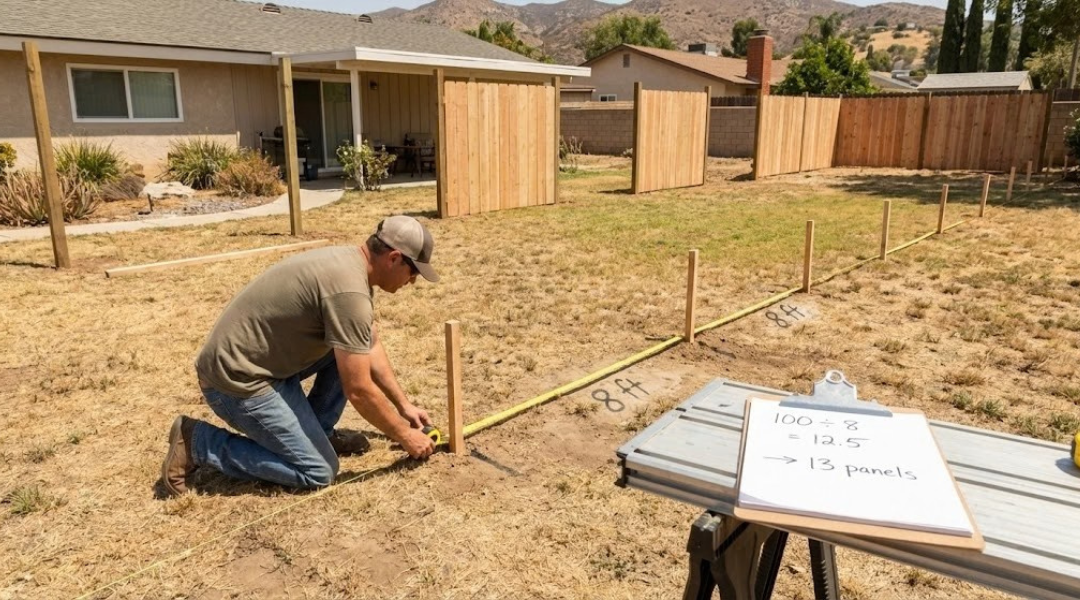
Different fence styles use different panel widths. Wood privacy panels typically come in 6 or 8-foot sections. Chain link fabric comes in rolls that you cut to size. Vinyl and aluminum fences often use 6-foot or 8-foot sections.
You can’t split panels at random points. Each panel needs support posts on both ends. This means your actual fence length might be slightly longer than planned to accommodate full panel sections.
Post Spacing And Load Distribution
Most fences need posts every 6 to 8 feet for proper support. Closer spacing creates a stronger fence but uses more materials. The type of fence you’re building determines the right spacing.
Heavy materials like solid wood panels need posts every 6 feet for stability. Lighter materials like chain link can handle 8 to 10-foot spacing. Wind exposure matters too. Areas with strong winds need closer post spacing.
Rails per section connect to each post and provide horizontal support. Most fences use 2 to 3 rails per section. The post depth should be at least one-third of the total post height above ground. A 6-foot tall fence needs posts buried 2 feet deep.
Gates As Structural Interruptions
Gates break up your panel count and need different support than regular fence sections. Standard walk-through gates measure 3 to 4 feet wide. Driveway gates range from 10 to 16 feet wide depending on how many vehicles need access.
Each gate needs two gate posts that are stronger than regular fence posts. These posts carry extra weight from the gate swinging and daily use. Most gate posts use 6×6 lumber instead of standard 4×4 posts.
Subtract the gate width from your total fence length before calculating panels. A 100-foot fence with one 4-foot gate only needs 96 linear feet of panels. The number of gates directly affects your material counts and cost.
Material-Specific Estimating Variables
Each fence material type has unique characteristics that affect how you calculate quantities. Wood requires extra material to account for waste, vinyl and aluminum use fixed panel sizes, and all fencing depends on accurate concrete calculations for post stability.
Wood Shrinkage And Waste Factors
Wood fence materials require higher material quantities than your basic measurements suggest. Pressure-treated lumber can warp, split, or contain defects that make some boards unusable. Plan to add 10-15% extra material to your estimate for a wood fence project.
Picket width and spacing affect your total picket count significantly. Standard pickets are 5.5 inches wide, but actual dimensions vary by wood type and milling. Measure the actual width of your chosen pickets before calculating how many pickets you need.
Rail length for wooden fences should account for cuts and mistakes. If you’re building a wood privacy fence with horizontal rails, order at least two extra rails per 100 linear feet. Pressure-treated lumber may also shrink slightly as it dries, which can affect picket spacing over time.
Waste factors by component:
| Component | Waste Factor |
|---|---|
| Fence pickets | 10-15% |
| Horizontal rails | 5-10% |
| Posts | 5% |
Vinyl And Aluminum Panel Standardization
Vinyl fence and metal fencing systems use standardized panel sizes that simplify ordering. Most panels come in 6-foot or 8-foot widths, and you must work within these fixed dimensions. You cannot cut vinyl panels to custom widths without compromising their structural integrity.
Panel width determines your post calculation directly. For a fence section using 8-foot panels, you need one line post every 8 feet plus corner posts at direction changes and end posts at terminals. A vinyl fence requires exact panel counts since you order complete units rather than individual pickets.
Gate hardware and reinforced gate posts must match your panel system. Standard line posts won’t support gate weight properly, so mark gate locations separately in your estimate. The panels needed for your project will dictate the exact number of posts required with minimal room for adjustment.
Concrete, Steel, And Footing Volume Implications
Concrete per post depends on post size, hole depth, and diameter. A standard 4×4 fence post in a 10-inch diameter hole that’s 2 feet deep needs approximately one 50-pound bag of concrete. Larger posts or deeper holes require proportionally more concrete.
How deep should fence posts be? Set posts at least one-third of their above-ground height below grade. A 6-foot privacy fence needs posts buried 2 feet deep minimum. Areas with frost require deeper footings to prevent heaving.
Chain link fence posts and metal fencing use the same concrete principles as wood posts. Calculate concrete volume by measuring hole diameter and depth, then multiply by the total number of posts. Corner posts and end posts often need larger diameter holes and more concrete for stability. Add 10% extra concrete to your estimate to account for spillage and hole irregularities.
Interpreting Estimates Through Tradeoffs
When you use a fence calculator or calculate materials for your project, the numbers represent choices with real consequences. Every estimate forces you to balance competing concerns about cost, risk, and long-term needs.
Overordering Versus Shortfall Risk
Adding 5-10% extra to your fence materials calculator results protects against running short mid-project. This buffer covers damaged boards, measurement errors, and cutting waste that happens on every job.
The risk of underordering is higher than most homeowners expect. A second trip to the lumber yard costs you delivery fees again, delays your timeline by days or weeks, and may leave you with mismatched materials if your original batch is out of stock. Wood fence posts from different lots can vary in color and grain pattern.
Overordering ties up money in materials sitting in your garage. But you can return unopened packages to most suppliers within 30-90 days. The sweet spot for most fence projects is 7-8% over your calculated needs for wood fencing and 5% for vinyl or metal materials that arrive in standard sizes.
Budget Sensitivity To Material Class
Your fence cost changes dramatically based on material choices. Switching from pressure-treated pine at $1.50 per linear foot to cedar at $3.50 per linear foot doubles your material budget on a 150-foot fence from $225 to $525.
Gates, posts, and hardware create fixed costs that stay constant regardless of your fence panel choice. A standard 4-foot gate kit costs $75-150 whether you build with budget pickets or premium boards. This means upgrading materials on a small 50-foot fence section impacts your total cost more heavily than the same upgrade on a 200-foot perimeter.
Calculate materials separately for posts, rails, and surface boards. You can mix material classes by using treated posts for ground contact while choosing cedar or composite only for visible pickets and rails.
Future Repairs And Compatibility Constraints
Buy 10-15% extra boards beyond your waste allowance and store them as repair stock. Manufacturers discontinue product lines every 2-3 years. That specific vinyl picket style or composite color may not exist when you need to replace damaged sections in five years.
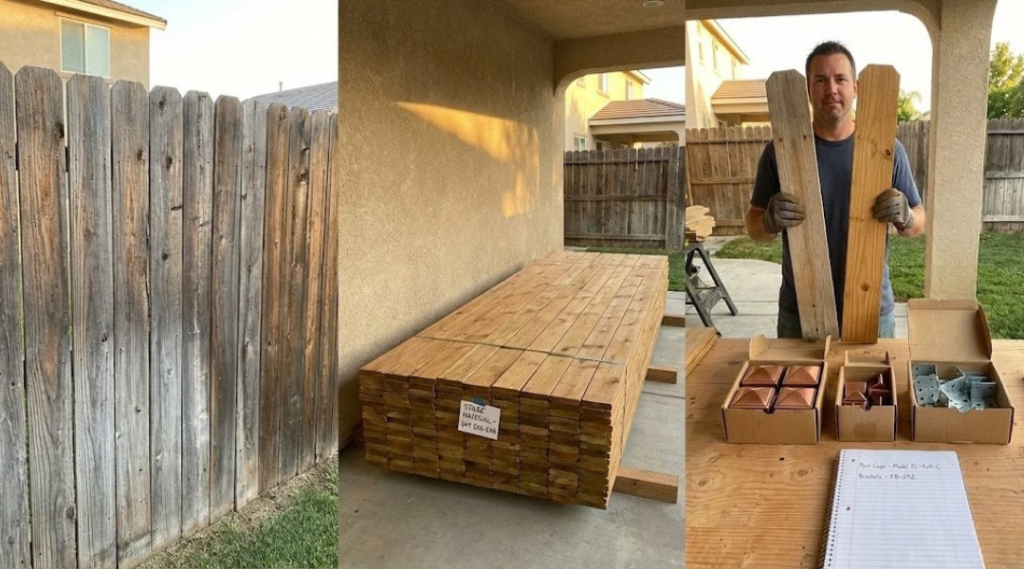
Fence materials age differently than fresh stock. A new pressure-treated board installed next to five-year-old weathered boards will look mismatched for 12-18 months until the color evens out. Pre-staining your repair stock at the same time as your original fence solves this problem.
Standard dimensional lumber like 2×4 rails stays available forever. Specialty items like decorative post caps, specific bracket styles, or custom-milled picket shapes create compatibility problems. Document your exact product names and model numbers when you calculate materials for your fence.
Estimating Realities Observed At Fence Specialties LLC In Riverside, California
Professional estimators and first-time installers approach material calculations differently, and regional factors in Riverside affect everything from post depth to material availability. Understanding these practical considerations helps you avoid costly ordering mistakes.
Contractor Versus Homeowner Quantity Assumptions
Licensed contractors typically add 10-15% waste factor to their material orders at Fence Specialties. You might think ordering exact measurements saves money, but experienced installers know better.
Professional buyers account for cutting errors, damaged boards, and unusable sections. They factor in corner posts, gate hardware, and extra concrete bags for Rocky soil conditions. Homeowners often underestimate these needs by 20-30%.
Common homeowner miscalculations include:
- Forgetting gate posts require larger diameters
- Not counting extra pickets for pattern matching
- Skipping spare fasteners and brackets
- Underestimating concrete for deeper holes
The staff at Fence Specialties’ Riverside location at 330 Main Street sees this pattern regularly. They recommend adding at least 8-10% to your calculated totals for wood and vinyl materials.
Stock Lengths And Regional Availability Patterns
Fence Specialties stocks materials in standard dimensions across their four California locations. Rails come in 8-foot sections. Posts arrive in 6-foot, 8-foot, and 10-foot lengths.
Your fence design must work around these fixed sizes. A 25-foot fence run requires four 8-foot rails, leaving 7 feet of waste per rail line. This creates 21 feet of unused material across three rail positions.
The Riverside and Oceanside branches carry the same core inventory, but quantities vary by local demand. Wood fencing moves faster in Riverside due to residential construction patterns. Vinyl and aluminum stock levels stay consistent year-round at all locations.
Same-day pickup works only when your needed materials are in stock at your chosen branch. Call ahead to verify quantities for orders over $500.
Soil And Climate Considerations In Riverside, California
Riverside’s clay-heavy soil requires deeper post holes than standard 24-inch depths. Most installations need 30-36 inches to reach stable ground and prevent shifting.
You’ll use 40-60% more concrete per post compared to coastal locations. The summer heat causes faster curing times, which affects your installation schedule. Plan to set posts early morning or late afternoon between May and September.
Riverside-specific adjustments:
- Add 6-12 inches to standard post depth
- Increase concrete by 1-2 bags per post
- Account for thermal expansion in vinyl materials
- Plan for minimal ground frost (rare below 3 inches)
The dry climate also affects wood moisture content. Pressure-treated lumber from Fence Specialties arrives at 15-19% moisture. It will shrink another 2-4% after installation as it acclimates to Riverside’s low humidity.